

The tarot was borne in the Italian Renaissance, not as a divinatory tool for occultists, but more as an aristocratic card game – something to wile away the hours of the prototypical idle feudal family. Tarot evolved into an oracle after a plethora of generations, most likely in Marseilles, and this was also about the time that the motifs and structure of the 78-card deck was standardized, with official card names and numbers for the trump cards.
While historians have determined that the characters in the trump part of the deck were derived from popular imagery of the 13th Century called trionfi, meaning “triumphs,” and were enhancements to already-popular playing card decks, an array of trumps that is remarkably similar to our contemporary “Rider-Waite Deck” existed in the 15th Century, and to that we must look for an astrological pillar.
In this article, I will offer up new insights into the astrological, or more specifically the astro-numerical, impetus of the tarot. This is based on the presentation I developed in February of 2020, which was then put on hiatus as the pandemic chaos took hold, and I couldn’t do things in public. So, here it is three years later, online! Are you excited yet? On the edge of your seat? Pi-curious?? This is for you, then.
First, some general info. The divinatory tarot has a standard deck with 78 cards. (78 is a special value, which will be explained as we progress.) The tarot is divided into two main sections, called the “minor arcana” and the “major arcana.”
The minor arcana is the part of the deck with four “suits” or “elements”: cups, coins, swords, staves. Within each element are ten “pip” cards that have a value from one to ten, and then four “face” cards that feature a knave, a prince, a queen, or a king. This dimension of the tarot is similar to the standard 52-card playing deck used extensively for gaming, but with four more cards per suit, thus, we have four suits of 14 cards that yield a total of 56 cards in the minor arcana.
The major arcana has 22 cards, but this is really 21 numerically-ordered cards and then one card, “the Fool,” which is numbered “0” but is really just a card without a value – a “wild” card. The Fool is the progenitor of the “Joker” card in a standard 52-card playing deck, which is also used solely as a wild card.
If we break this down into a tabular format, the basic math of the deck looks like this:

Here we see that out of a deck of 78 cards, 77 are of a fixed value and 1 is of a sort of “hyper” value, meaning nothing, or it can take the place of any other card. The Fool card has a sort of supernatural power, a “magic.” This is where we have to confront the possibility that there was indeed some kind of “occult” or “sacred” schemata to the 78-card deck, as these divisions are a sort of exercise in both rational mathematics (the profane) as well as the realm of “irrational” numbers (the sacred). First, let’s look at the profane math.
We notice that the number 7 is a prolific factor, and 7 is a prime number. We can write the formula as:
[(7 x 11) + 1 = 78] where all numbers in the formula are primes, or:
[(2 x 3 x 13) = 78] which is the actual prime factorization of 78.
Prime numbers aren’t all that special in the modern consciousness, but they did have a sort of mystic quality in the Medieval mind. Of those, the number 7 had an extra special significance as its reciprocal is a somewhat complex decimal (the decimal point wasn’t really a thing until the 17th Century) that repeats ‘142857142857’, but more esoterically as the number of days in the week – days that are named for the seven classical planets – Moon, Sun, Mercury, Venus, Mars, Jupiter, Saturn.
The standard 52-card deck of four suits of 13 cards is easily seen as the number of [7-day] weeks in each of the four seasons (91 days = 7 x 13), and that there are 52 weeks in a year, adding up to 364 days plus one day to give 365. The 78-card composition therefore “conjures up” a 7 into reality from the aether of implied value, and “disappears” the 13 back down into the aether with the major arcana addition to the deck.
This math, therefore, gives us a hint at why a Fool card was given a kind of magical role in the scheme, eventually being given the value of Null. It’s important to remember the occult principle of “±1” in this context. If there is anything that is the opposite of zero, it is one, and such ideas are there for us to contemplate.
Aside from those minor acrobatics of whole numbers, we have also to consider the sacred values of what we now call “irrational” numbers, or numbers with decimal points that go on forever and never repeat any sequence of digits. The two most famous of those are, of course, pi π and phi φ. The former is the number that represents the number of diameters of a circle that make up its circumference, and the latter is the Golden Mean, which is approached by a continuation of the Fibonacci sequence, but is also the only number that is the reciprocal of itself ±1: [1 ÷ 1.618033988749895… = 0.618033988749895…].
In the 21st Century, we don’t teach children that π is a fraction, but instead a simple decimal number: 3.141592653589… However, in ancient times it was the practice to use fractions that approximate such values, and the closest fraction that involves small numbers is 22/7, which gives us 3.142857142857…. This approximation is close enough for practical uses, such as in construction, or in artisanal work, but also achieved a more sacred and “mystical” connotation as “squaring the circle” was an ancient concern in mystery schools. It is thought that the number of letters in the Hebrew alphabet – 22 – was based on this sacred ratio, which prompted the early tarot esotericists to give each trump a Hebrew letter.
In any event, the major arcana is [21 + 1 =22].
φ is a bit more complicated to discover in the tarot, but when we look at the actual Fibonacci sequence, some things become clearer:
0, 1, 1, 2, 3, 5, 8, 13, 21, 34, 55, 89, 144, 233, 377, 610, 987, 1597, 2584, 4181 …
Here we can see that the number 21 pops up, which is the number of numbered trumps, and is part of our formula for the major arcana of [21 + 1 = 22]. We also can see that the number 55 is present, and we can add a mirroring formula for the minor arcana: [55 + 1 = 56].
At this point, we have established a matrix of interconnecting sacred and profane maths, or a kind of special tarot-numerology. Are these symbolic gestures repeated in the actual deck? Our first step is to see which trumps have values that are also in the Fibonacci sequence, looking at an early 18th Century deck from Charles Cheminade:
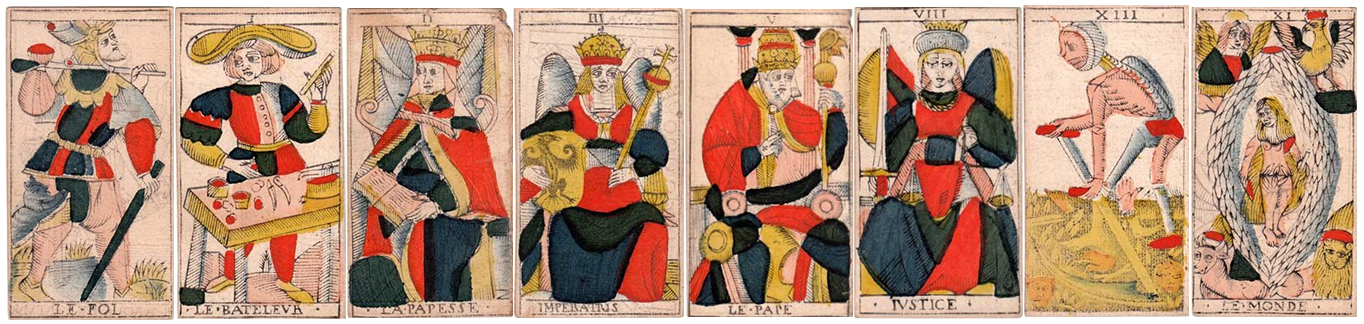
Much could be said about this, but it is interesting that Death (unnamed in this deck, very superstitious!) shows up as the second-to-last card before the World. Note that the World is not a circle, as in earlier deck motifs, but instead a vesica piscis, symbolizing the birth canal with a feminine character at the center; the zodiac signs of the fixed signs of the cross-quarter points suggests that the beginning of life is of heavenly origin.
If we remove the Fool, we are left with seven cards; the sequence is thus [7 + 1 = 8].
Of note here, the modern Rider-Waite deck switches the Justice card’s place in the sequence with Strength, making Justice #11 and Strength #8. Was part of Waite’s occult message with this that “8” and “11” are somehow interchangeable? The Fibonacci sequence above only has two non-primes, and if the “11” is implied in this sequence, then the only remaining non-prime would be the “21”, which is of course [7 x 3]. The prime factorization of 22 is [2 x 11].
As for π, we might imagine that the “22/7” formula would include both the seven Fibonacci sequence cards as a diameter, and the twenty-two of the whole major arcana as the circumference.
So, what does all this have to do with ancient astrology?
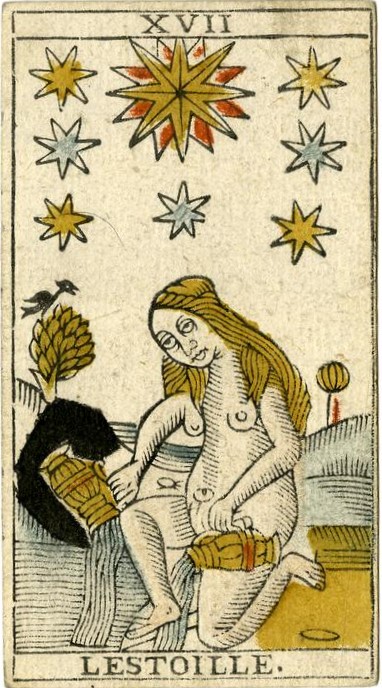
From the earliest known tarot deck, the three astrological cards – The Star, The Moon, and The Sun – were in sequential order. These cards now have the values 17, 18, and 19. Evidence exists that some early decks had the sequence of 16, 17, and 18, though this is somewhat sketchy. The earliest decks did not have numbers or titles in the artwork, such as the Visconti deck, which is reproduced here:
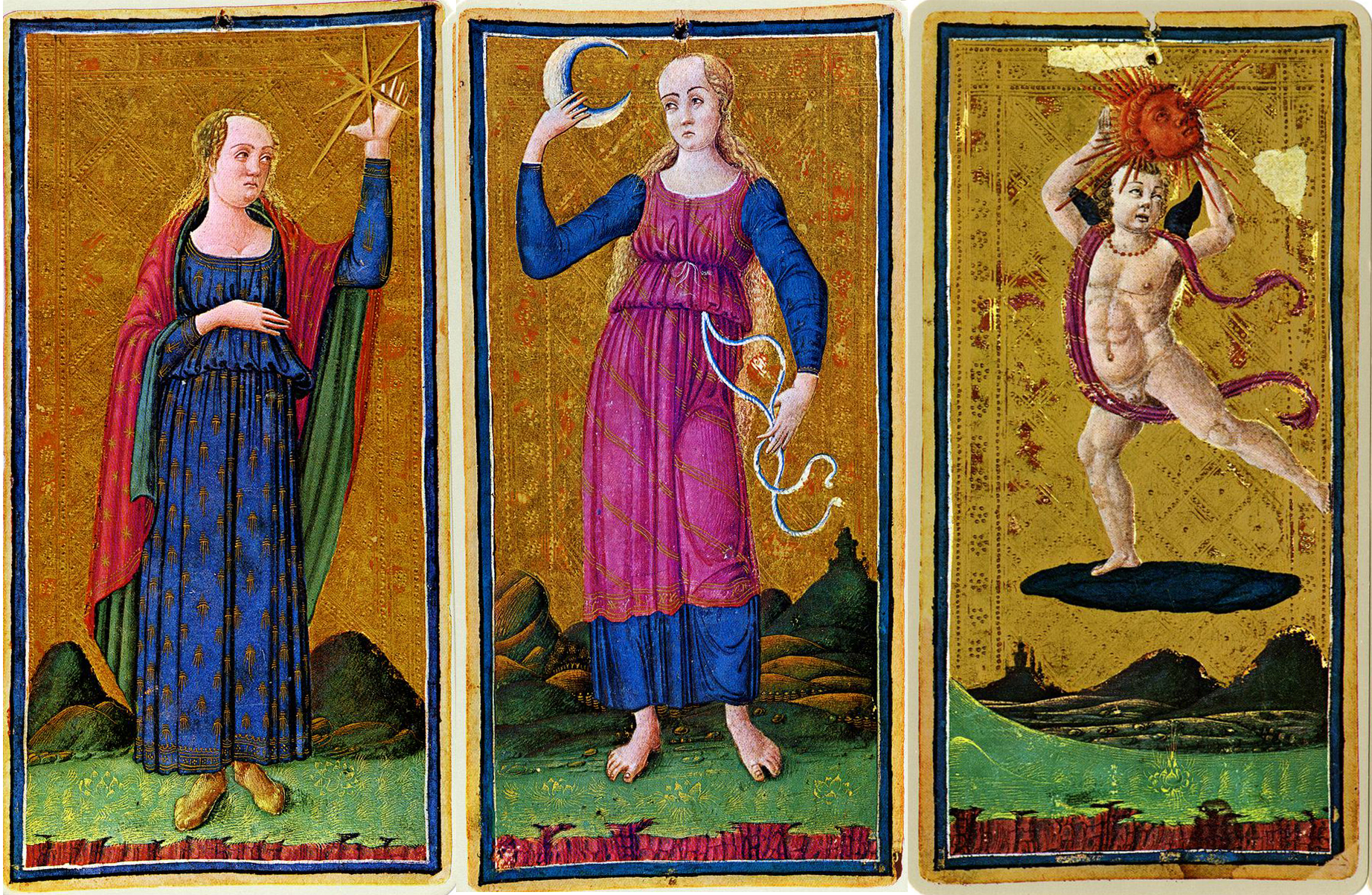
It was just assumed that a card player knew which cards were more valuable than the others. The Visconti deck depicts the Star and Moon with female characters, while the Sun has a masculine. These gender-associations have carried forth through the ages, though the Moon card has dropped the person’s torso, and just has a feminine spirit in the orb.
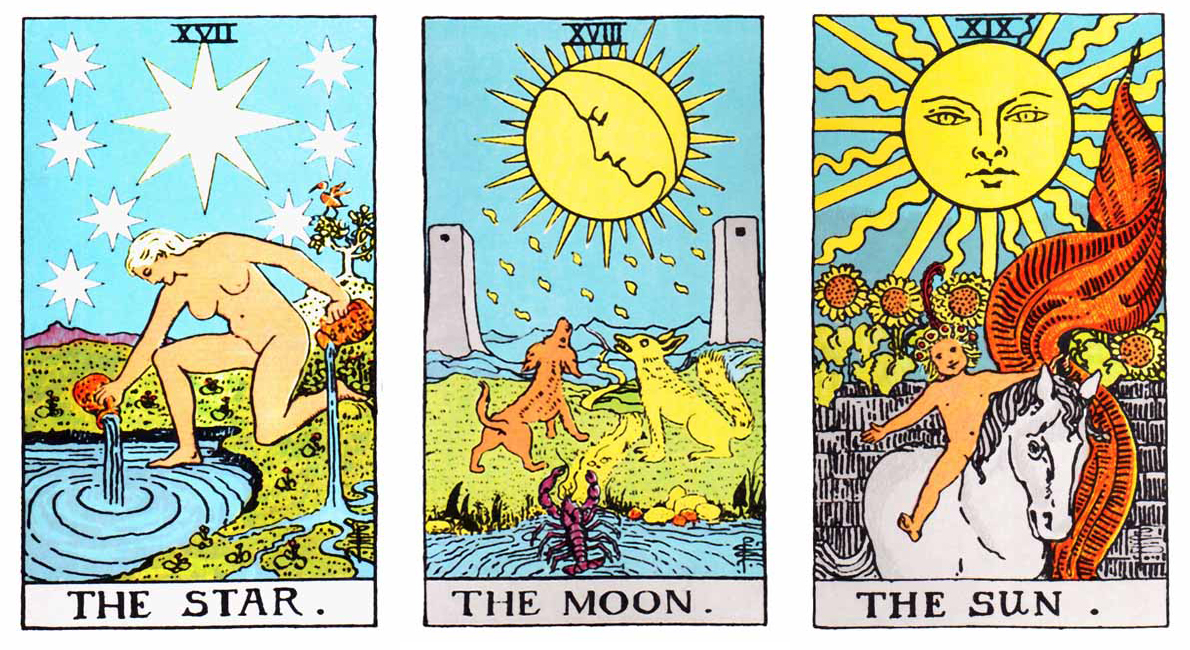
We know what the Sun and Moon are supposed to represent in the cosmos, but what is the Star? Is it a particular star in the sky? Is it a constellation? Is it indicative of a person’s astrology chart? What exactly was a “star” in the early Renaissance? Was this meant to be the vaunted biblical Star of Bethlehem? While we modern folks know there is a big difference between planets and stars, thanks to telescopes and photography, the distinctions in the classical period were not so fine.
Let’s consider two things: 1) while the classification of a “planet” meant the points of light that moved against the gradient of constellations of the heavens, they were thought to be of similar substance as the “fixed stars” that formed permanent constellations and did not move; 2) while it was generally understood that the various moving stars were at different distances from the stationary Earth, the fixed stars were thought to all be equidistant from the earth, on a large sphere that moved around the stationary Earth. Thus, it is plausible that the Star card was meant to represent all heavenly points of light that are not the Moon and Sun.
But, that pesky gender association remains, and given that there is not a constellation of stars in the original Visconti artwork, and instead just one spiky star, the assumption can be made that the Star is a specific star, and that anyone from that era probably would have known which one it is.
My personal thesis is that the Star is the planet Venus. I have my reasons, too.
Venus is the third brightest heavenly apparition, with the Moon being the second-brightest and the Sun being the brightest, and so it makes sense that this triumvirate would be placed in this ascending order. Another less-known facet of Venus is that it is visible to the naked eye in the daytime, when the Sun is well above the horizon. It’s not very easy to find, but it is possible, and the ancients knew this. The Sumerians actually grouped Venus with the Sun and Moon in their hierarchy of celestial deities; this is depicted on the cover of the cover of Gavin White’s Babylonian Star Lore:
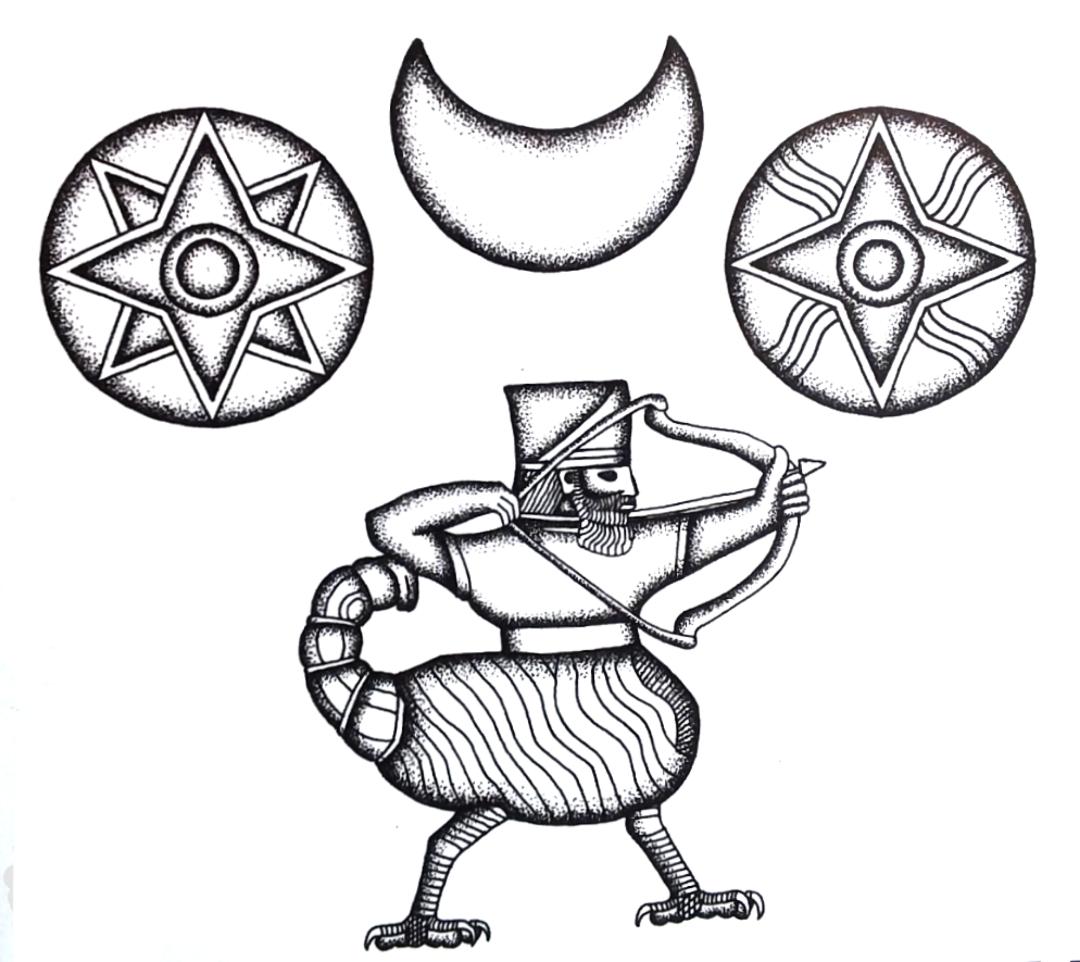
We can see that Babylonian Venus has eight “spikes”, while the Sun has four “spikes” and also rays, while the Moon is of course a crescent. The “eightness” of Venus is directly related to something called the “Goal-year” value, which all of the planets were given by the Babylonians. These values were basically the number of years it took for a planet to return to a place in the sky.
For example, if we measured the position of Venus as 10° of Cancer on a certain date, let’s say July 1, we could be certain that in eight years Venus would return to that degree of Cancer, within a very small error.
These values were listed out in the late Babylonian period in what were called “Goal-Year Texts.” They were given in Ptolemy’s Almagest, and the values for all the planets are as follows:
- Sun – 19
- Moon – 18
- Mercury – 46
- Venus – 8
- Mars – 79 (or 47)
- Jupiter – 83 (or 71)
- Saturn – 59
It should go without saying that the Goal-Year values for the Sun and Moon have a different standard than the other five planets, and I will explain that, but it should be obvious that their Babylonian “Chaldean” values match the sequence numbers in the tarot.
Also of note here is the very old observation that Venus, during its 8-year cycle, makes 5 conjunctions with the Sun, etching out an approximate pentacle within the circumscribed sphere of the outermost layer of the heavens.
The Moon’s association with an 18-year cycle comes from the “Saros,” an observation that lunar eclipses will “repeat” every 18 years and ten days, or a span of 223 lunations (a lunation being the time from one “new” moon to the next, or about 29.5 days).
The association of 19 with the Sun is also related to lunations, and the observed calculation that a new or full moon will occur at the same place in the zodiac every 19 years, or 235 lunations. This is known as the “Metonic” cycle. The following graph is taken from Robert Van Gent’s excellent page on soli-lunar cycles:

The “19” is attached to the Sun in another relic of Babylonian astrology – the planetary “exaltations.” The origins and rationale of exaltations were basically unknown to Renaissance astrologers; they were listed by sign only in Ptolemy’s Tetrabiblos, but listed by degree of sign in Medieval Islamic works by authors such as al-Bīrūnī:
- Sun – 19° Aries
- Moon – 3° Taurus
- Jupiter – 15° Cancer
- Mercury – 15° Virgo
- Saturn – 21° Libra
- Mars – 28° Capricorn
- Venus – 27° Pisces
19° of Aries equates to 19 years if we accept the “day-for-a-year” astrological technique. Aries is the first sign of the zodiac, and the Sun moves through it at the beginning of the spring season, returning to dominate the length of daytime and also the return of flora.
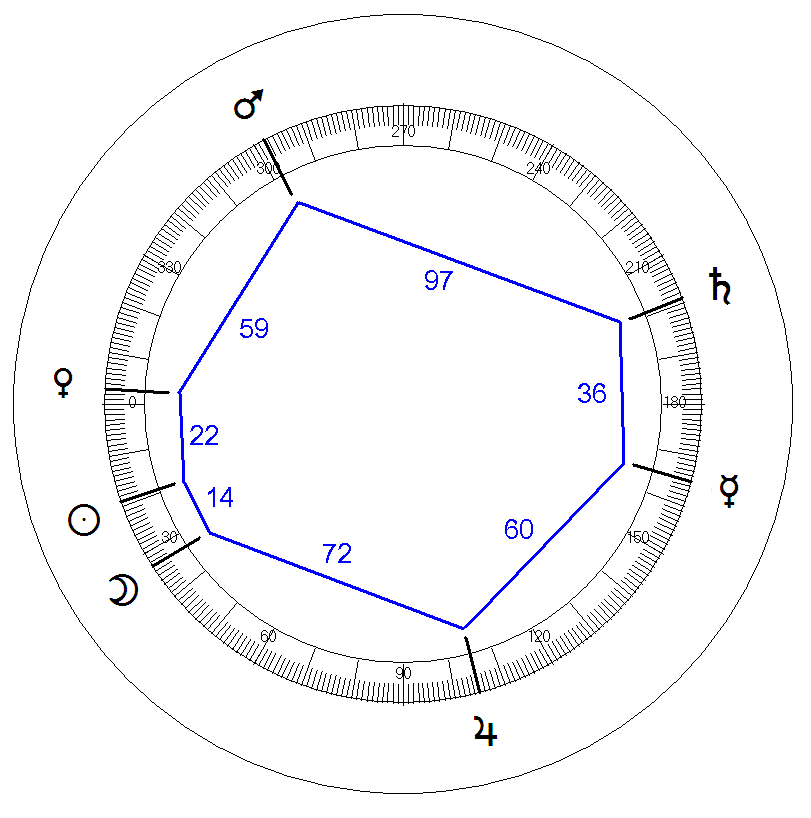
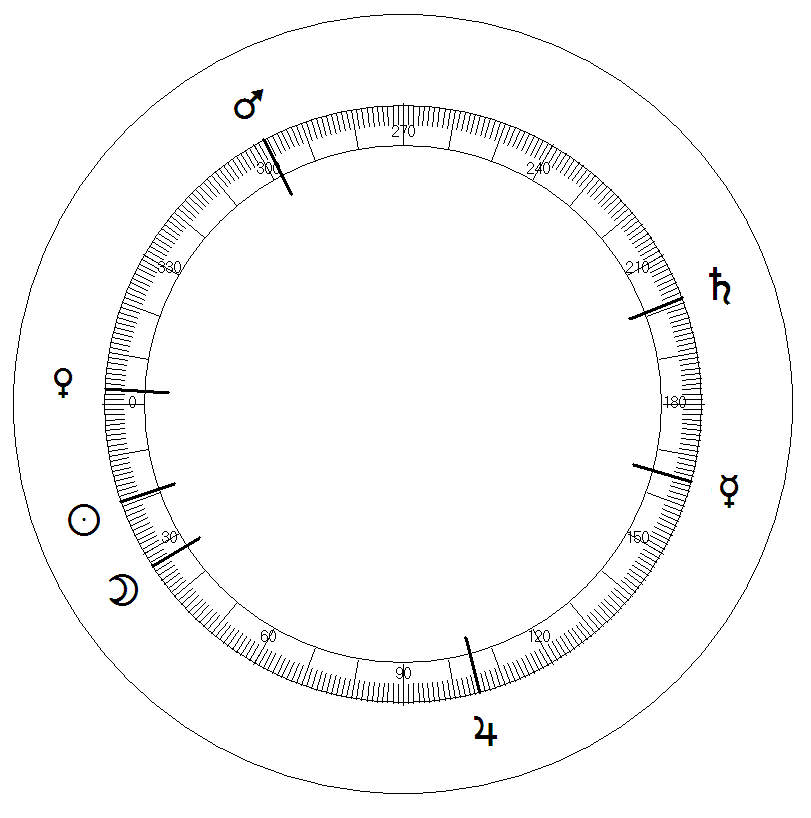
The wheel to the right shows the placement of exaltation points around a 360° wheel, with the 0 on the left representing the beginning of Aries. The symbol for the Sun is the circle with the dot in the center. Moving counter clockwise, we come to the Moon, Jupiter, Mercury, Saturn, Mars, and finally Venus.
It’s easy to see here that Venus, Sun, and Moon are clustered on the left side of the array, and almost in the same order as the tarot’s Star-Moon-Sun. Looking deeper at this distribution, things get a bit more interesting.
When we calculate the number of degrees between each exaltation, some familiar values appear: 22° separates Venus and the Sun, while 14° separates the Sun and Moon. These are the same values as the major arcana of 22 cards and one suit of 14 cards.
The span between Venus and Moon is 36°, which is 1/10 of 360° If we take the Venus-Sun distance and divide it by the Venus-Moon distance, we get this:
[22 ÷ 36 = 0.611111…]
The product is very close to value of φ: 0.618033. the 14 and the 22 are both “+1” of the Fibonacci sequence numbers of 13 and 21.
Another numerological coincidence pops out with the Saturn-Mars and Mars-Venus values of 97 and 58:
- 59 + 19 = 78
- 97 – 19 = 78
All that remains to peg the Star card as Venus is an explanation of why it deserved the number 17. As a prime number, it brackets the Moon card’s 18 along with the prime number 19 for the Sun card.
But, is the 17 a prime factor of a larger number? The exaltation of Venus is 27° Pisces, which is only three degrees short of the vernal point, and Aries, and starting the count all over again. If we see 27° Pisces as 357° of the whole 360° circle, we find that the prime factorization does indeed include 17:
[3 x 7 x 17 = 357]
Three sevens gives us the Fibonacci number at the end of the major arcana, 21:
[17 x 21 = 357]
Returning to more standard astrological themes, we do know that Venus “rules” over two zodiac signs – Taurus and Libra. Given that the animal symbol for Taurus is a bull – a decidedly masculine and Mars-like creature, we have to ask how Venus came to be affiliated with Taurus.
The answer lies in the prominent nebula that used to be its own constellation before the Babylonians invented a standardized zodiac of 12 equal divisions of the planetary path across the heavens – the Pleiades.
The Pleiades was associated with spring rains in ancient Mesopotamia, partly for having a cloudy appearance (clouds make rain), and partly because the apparent Sun’s passage through that zone of sky was associated with rising river levels due to snowmelt from the Taurus mountains, and also spring rains. The moniker of the “Seven Weeping Sisters” for the Pleiades’ seven visible stars within the nebula surely has much to do with rain.
Venus, too, is associated with moist weather, as is the Moon that rules over the first “water” sign called Cancer. The Moon is exalted in the early part of Taurus because this is where the Moon would meet up with, and sometimes occult (move directly in front of), the Pleiades. Ancient, pre-zodiac star lists from the Babylonian realms usually began with the Pleiades and then went around the sky – that’s how important the Pleiades was to the burgeoning civilizationists who knew water was essential for survival.
The evolution of imagery for the Star card keeps the female figure, and then adds two dispensing urns of water. Also, the number of stars increases from one to 7 or 8, depending on the deck. Usually there is one big star and the rest are uniformly smaller.
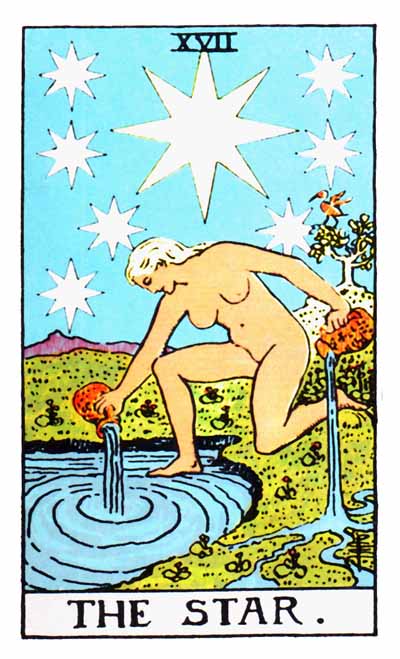
The card titled “LESTOILLE” shown here is from 1680 France, part of a deck called the Guilaume Debusset tarot, and it is remarkably similar to our more contemporary Rider-Waite Star card from the early 20th Century. Even the word “LESTOILLE” is a play on words, as it means a spring of water, or a water source, whereas the French word for “the star” is “le toile.”
The number of stars in the artwork’s constellation is similar, and the smaller stars surround the Pleiades, as if the planet Venus is passing directly through the Pleiades, which it does on occasion.
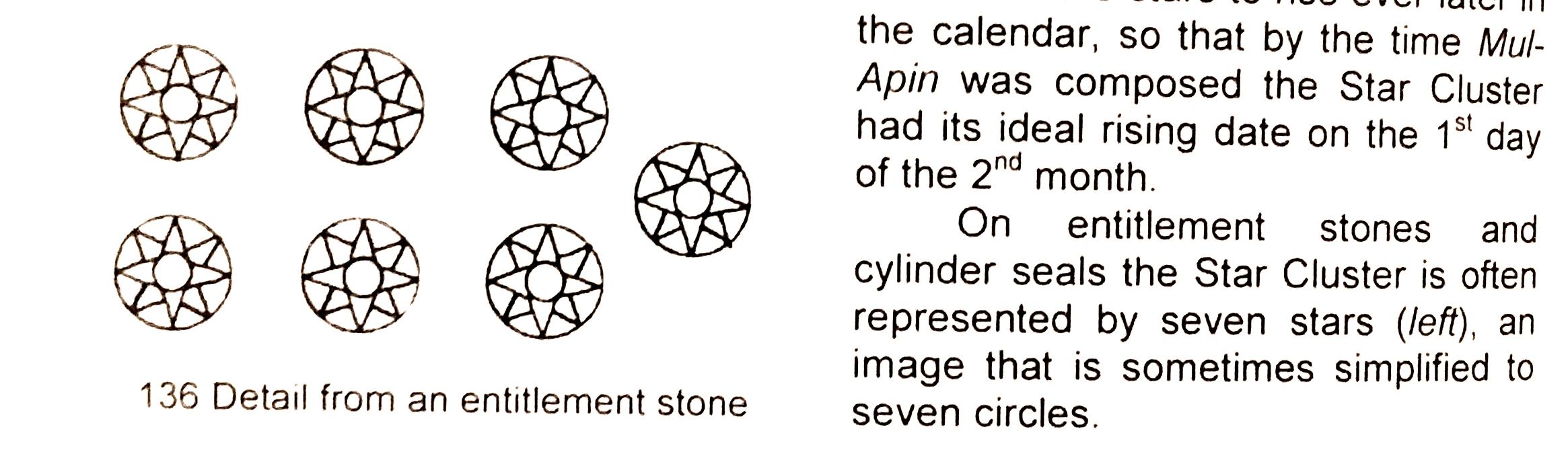
And if that’s not enough, the ancient Babylonians graphically represented the Pleiades as a cluster of eight-pointed stars, mimicking the eight-pointed motif for Venus.
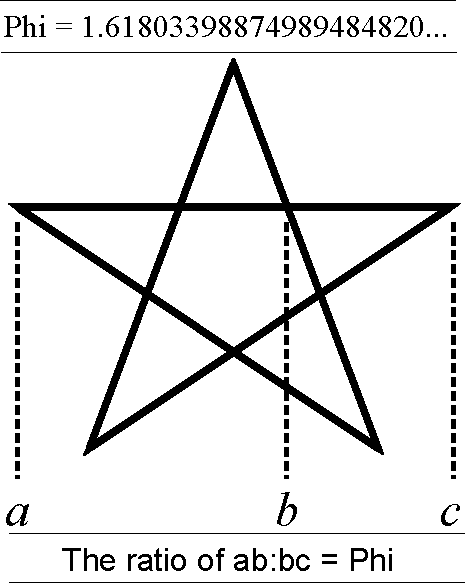
Returning finally to the ancient knowledge of five Venus/Sun conjunctions in an 8-year cycle making a pentagram shape in the sky, the pentagram does accurately factor in φ, and thus the “phi-ness” of the tarot has a robust multi-layered symbolism.
In conclusion, when all of this evidence is considered, a strong case can be made that the Star trump card is indeed Venus. The implications of this requires another look at some of the other tarot motifs and designs, and we will explore that in the near future.
-Ed
 Emersion: A Blog from Occursion Media on Somewhat Interesting Hidden and Cryptic Astrological Histories
3 thoughts on “Astrological Elements of the Tarot (no, not what you’ve read before) Part I”