
This article was published online in 2003 as a three-part series by Ed Kohout, based on discussions with historians Rab Wilkie and Jeff Nisbet. I am indebted to both for their knowledge and patience. Apologies for the low quality graphics and obsolete links.
Rosslyn Facts and Lore

In his article, Secrets of Rosslyn Chapel Unveiled: A Painstaking Investigation Puts the Ancient Enigma in a Dramatic New Light,1 Jeff Nisbet makes some assertions, one of which is this:
Rosslyn Chapel was founded upon St. Matthew’s Day, 21 September, 1446, and officially dedicated to that saint on the same day in 1450. Since September 21 marks the Autumnal Equinox, when the sun rises exactly due east of Rosslyn, I decided to see if the Earl had written something in the sky above, that might have reflected the truth he’d been carving on the earth below. I wasn’t disappointed. My previous Atlantis Rising articles propose that an “inner circle” of the Knights Templar escaped the order’s suppression in 1307 France, going “underground” in Scotland, while continuing to send what they believed to be “Truth” forward to more enlightened times by secretly hitching rides on both the astrological mythologies of a past they believed to be rooted in “fact” and the astronomical discoveries they knew would be found “when the time was right.”
Nesbit eventually asserts that the Templars had some knowledge of the planet Neptune some four centuries before its discovery — a claim that is not the focus of this web essay. Instead, I my aim is to offer a more detailed explanation of the astrology surrounding 1446.
The chapel at Rosslyn, Scotland, has been the focus of many recent works of research into the heritage of Freemasonry’s symbolism. Tim Wallace-Murphy, Christopher Knight and Robert Lomas, and Graham Hancock are at the forefront of this work, and others have given excellent studies. In comparison, this author is woefully ignorant of much of the finer points surrounding this marvelous shrine, and I am in no way an authority able to make assertions of the veracity of much of the historic claims floating about. Much effort has been given to using Rosslyn as proof of the connection between neo-Templarism and speculative Freemasonry, but those near to the chapel will distance themselves from such arguments. However, as we will see, there are contentions that have not been settled, as we see in the words of Peter Cummings:
This landmark is 9 miles south of Edinburgh, and 2 miles east of Roslin Village, Scotland. It was built in 1446 by William St. Clair, 11th Baron of Roslyn, Last Earl of Orkney and 1st Earl of Caithness. Because of its elaborate stone carvings, this often is called a “Bible in Stone.” The most well-known carving is the “Prentice Pillar”. Other carvings depict Templar secrets and the Green Man traditions.
There is no direct link from the Templars to the clan of “St. Clair,” of which we get “Sinclair,” who were the wealthy family that funded the construction of the Temple. On the other hand, there are definite links to the posterity of the 15th Century Sinclairs to the 18th Century Sinclairs that were heavily involved in so-called “Ancient” Speculative Freemasonry. James T. Watson, Jr. writes of the Sinclair’s Masonic roots:
The founder of the chapel was Sir William St. Clair (Sinclair), third and last Earl of Orkney. He lived during the reigns of the Scottish Kings, James I, II and III, who gave to the St. Clair family the office of Hereditary Grand Master of the Order of Freemasonry in Scotland.
A later William St. Clair was the last to hold that title, and the last man buried in the vaults of the chapel. A member of Canongate-Kilwinning Lodge #2 and childless, he was instrumental in forming the Grand Lodge of Scotland. Unanimously elected the first Grand Master by the 32 Lodges meeting in Edinburgh on St. Andrew’s Day, November 30, 1736, he was succeeded by the Earl of Cromarty in 1737. “The Lodge of St. Andrew’s of Boston New England,” chartered by the Grand Lodge of Scotland on November 30, 1756, continues to meet in Boston.

Yet, nothing is written about the astrology of Rosslyn, if indeed there is any. We do know that the “foundation stone,” which would be called a “cornerstone” in later days, was laid specifically on September 21, 1446 — St. Matthew’s Day in the Christian calendar, and the patron saint to whom the Chapel is dedicated. It should be noted here that this ritual date is prevalent in actions of the Scottish Rite in the USA, and it is familiar as the date that marks the fall equinox, as it did in the early Roman Julian Calendar. As can be seen in the inset graphic, at the time of the Nicene Ecumenical Council in 325 AD, the fixed star Spica — the Virgin Mary’s spike of wheat — was near to this equinoctial point. In Babylonian astrology, Spica was used as a marker for equinox as well, and Cyril Fagan later proved that Spica was located at 29° of Virgo in the “sidereal zodiac.”
The Nature of Virgo and Spica
Nisbet also makes this revealing observation in the same Atlantis Rising article:
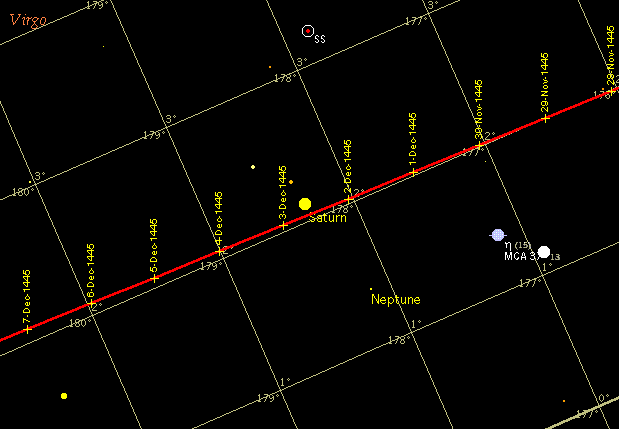
Earl William knew that even a book “carved in stone” could be pounded to dust, so he wrote his testament on the inviolable daytime sky, and hid it in the light. In “Rosslyn: Guardian of the Secrets of the Holy Grail”, by Tim Wallace-Murphy & Marilyn Hopkins, the authors claim that the site had been “revered by the Druids as the oracle of Saturn, the supreme Guardian of Secrets.” According to my research, it seems they are right. When Rosslyn was dedicated on September 21, 1450, the sun had risen exactly due east. Throughout the day, behind the sun and in exact alignment with the earth lay the planets Saturn and Neptune, a conjunction that occurs only once every 36 years. And they all rose invisibly in the light of day within the constellation Virgo, symbolic of various goddesses found in diverse astrological traditions.
Spica and Virgo, in an astrological sense, have always been given favorable treatment. Robson2 puts forth the following:
Influence. …It gives success, renown, riches, a sweet disposition, love of art and science, unscrupulousness, unfruitfulness and injustice to innocence.
If rising or culminating. Unbounded good fortune, riches, happiness, ecclesiastical preferment, unexpected honour or advancement beyond native’s hopes or capacity.
With Sun. Great and lasting preferment, eminent dignity, immense wealth, great happiness to native’s parents and children, help from friends among clergy, favourable for public and legal affairs. If culminating, Church and State preferment. If with Venus and Mars also the native is a potent king obeyed by many people, but subject to many infirmities.
With Moon. Gain through inventions, success, wealth and honour from Mercury, Venus, or Jupiter people.
With Mercury. Neat, tidy, clever, ingenious, favour of clergy and people in authority, gain through investment, responsible position.
With Venus. Benefits from friends, social success, false friends of own sex.
With Mars. Popular, social success, may have good judgment and quick decision or be violent in dispute, rigid, and nearly or quite a fool.
With Jupiter. Popular, social success, wealth, ecclesiastical honour and preferment.
With Saturn. Apt to be suspicious, sharp or fogged, but does much good, occult interests, good speaker, popular, many friends, gain through legacies but extravagant, good health, favourable for domestic matters.
With Fortuna. Great Wealth, voluptuous propensities.
The constellation of Virgo has symbolized the Virgin Mary since the earliest days of Christianity. Before that time, the constellation was most always associated with a female deity. Gettings says about the Constellation:
“Virtually all the ancient and modern traditions visualize the image of Virgo as a maiden, and a whole string of feminine names have been applied to her, such as ‘Persephone’ or ‘Proserpina’ — but in essence she has been regarded as the archetypal woman, the ‘Kore’ of the Greeks, the ‘Puella’ of the Romans, and in the Hindu asterisms as ‘Kanya’ (maiden): from very early Christian times she has been ‘Virgin’ or ‘Virgin Mary’…. Some of the more important variant names have revolved around the identification of the lucida in the asterism, the SPICA usually visualized as a set in the Virgin’s left hand or shoulder, as a child or as a sheaf of corn. The Greek name means ‘ear of corn’, and this was sometimes adapted by the Christians to the distaff which properly belonged to an heretical Gnostic tradition: later Christians visualized the star as an image of the Child in the arms of the Virgin Mary…. The link between the star and corn was sufficient to establish the entire asterism as the corn-goddess Demeter, from which we have ‘Arista’ and ‘Arista Puella’, the ‘Maiden of the Wheatfield’. But it was mainly in the image of the celestial mother that Virgo was visualized — called even ‘Astraea’ after the starry daughter of Themis: several of the medieval images of the Virgin Mary depict her dress decorated with stars (even with ears of corn) and were doubtless derived from the pre-Christian stellar goddesses….3
Another quality synopsis of Virgo lore is given by Olcott:
In the astronomical records of every age and race extant we find references to the constellation of the Virgin, and there is every reason to believe that it was one of the first star groups to receive a name. On the ancient maps, the Virgin is generally represented as a woman with wings, in a walking attitude. In her left hand she bears a bead of wheat, or ear of corn, which is marked by the brilliant first magnitude star Spica. … According to the poets, this Virgin was Astræus and Aurora, and the goddess of justice. Near her appear the Scales in which, it is said, she weighed the good and evil deeds of men. In the golden age she resided in the earth, but becoming offended as the wickedness of mankind she returned to heaven. Hesiod claimed that she was the daughter of Jupiter and Themis, and Aratos fives more space to the history of this constellation in his celebrated poem than to any other constellation. His account is as follows:
Once on earth
She made abode, and deigned to dwell with mortals
In those old times, never of men or dames
She shunned the converse; but sat with the rest.
Immortal as she was. They call her Justice.
Gathering the elders in the public forum.
Or in the open highway, earnestly
She chanted forth laws for the general weal,
Nor yet was known contention mischievous,
Nor fierce recrimination, nor uproar,
So lived they. Far off rolled the surly sea,
No ship yet from a distance brought supplies
But ploughs and oxen brought them. Queen of nations,
Justice herself poured all just gifts on man.
As long as earth still nursed a golden race
There walked she, but consorted with the silver
Rarely, and with reserves, nor always ready;
Demanding the old custom back again.
Nor yet that silver race she quite forsook.
At evening twilight, from the echoing mountains,
She came alone. No gracious words fell from her
But when the people filled the heights around
She threatened and rebuked their wickedness,
Refusing though besought to appear again;
“How have your golden fathers left a race
Degenerate! But you shall breed a worse
And then shall wars, and then shall hateful bloodshed
Be among men; and grief press hard on crime.”
This said, she sought the mountains, and the people
Whose eyes still strained upon her, left for ever.
And when these also died, those others sprang,
A brazen race, more wicked than the last.
These first the sword, that roadside malefactor,
Forged; these first fed upon the ploughing oxen.
And Justice then, hating that generation,
Flew heavenward, and inhabited that spot
Where now at night may still be seen the Virgin.Virgo was also identified with Erigone, the daughter of Icarus, who hung herself when she learned of her father’s death. In classic times she was associated with Ceres, of her daughter Proserpine. Proserpine, so the legend relates, was wandering in the fields in the springtime, and was carried off by Pluto to be his wife. Ceres besought Jupiter to intercede in the matter, and consequently Proserpine was allowed her liberty at intervals.
This myth is regarded as an allegory. Proserpine represents the seed which is buried in the earth, and in proper time bursts forth into bloom.4
Virgo as Isis
Other sources cite Virgo as being the stellar icon of the Egyptian goddess Isis, but such analogies are directly related to the zodiac of Dendera, which was of a decidedly Greek influence and not at all reflective of the Egyptian reality in earlier times when Sirius was identified with Isis.
In Egypt Virgo was associated with Isis, and it was said that she formed the Milky Way by dropping innumerable wheat heads in the sky.
Another version of this myth is that Isis dropped a sheaf of corn as she fled to escape Typhoon, which, as he continued to pursue her, became scattered over the heavens, thus producing the Galaxy which has all the appearance of glittering grains of golden corn.5In the Zodiac in the temple of Dendera, in Egypt, about 2000 B.C. (now in Paris), she is likewise represented with a branch in her hand, but ignorantly explained by a false religion to represent Isis! Her name is called Aspolia, which means ears of corn, or the seed, which shows that though the woman is seen, it is her Seed who is the great subject of prophecy.6
In Egypt Virgo was drawn on the zodiacs of Dendera and Thebes, much disproportioned and without wings, holding an object said to be a distaff marked by the stars of Coma Berenices; while Eratosthenes and Avienus identified her with Isis, the thousand-named goddess, with the wheat ears in her had that she afterwards dropped to form the Milky Way, or clasping in her arms the young Horus, the infant Southern sun-god, the last of the divine kings.7
The Royal Observatory at Greenwich
It is a documented fact that John Flamsteed (1646 – 1719), the first “Astronomer Royal”, chose to have the star Spica culminating for the moment of the cornerstone laying of the Royal Observatory at Greenwich. “When John Flamsteed laid the first stone of the Greenwich observatory on 10th August 1675 he also drew a horoscope for its founding, at 3.14 p.m. in the afternoon. Flamsteed was not a believer in astrology – in fact he had written a short pamphlet against it some years earlier – but it was a popular diversion in those times. So he wrote on the observatory horoscope in Latin, “Risum teneatis amici” – “This will keep you laughing my friends”.8 The New Style equivalent is August 20, 1675, and this gives us Spica on the meridian:

The question we need to ask, then, is what was astronomically special about St. Matthew’s Day of 1446 that might have been of importance and reverence for a Scottish Masonic guild that desired to craft a special memorial to their peculiar beliefs. Can we find some special circumstances surrounding Virgo in 1446, and more specifically September 21, that would propel the Sinclairs to sanctify the foundation stone on this date — four years before construction was to begin in earnest?
Astrological Alignments of Note in 1446
Spica and the Equinox
According to Masonic tradition, temples are to be laid out on an east-west axis, with the entrance on the west and the altar in the east. Rosslyn is no exception, and it platted exactly east-west. Theoretically, the equinoxes provide a sunrise that is exactly east, what we know as 90° Azimuth. (The best date for this would have been September 14, when the first shadows cast by the Sun would be directly west. The reason that the 21st was not the best day in 1446 was due to the fault in the Julian calendar that allowed a slight drift in the equinoxes from their original dates of March 25 and September 24.) Observations would also have been required on the previous solstice dates of Christmas and St. John’s Day, December 25 and June 24, respectively.
The obvious place to start is with a star chart for Spica transiting the meridian on Sep. 21 of 1446. Here we can see that there is a new moon in Virgo, and that the Moon culminates only 115 seconds sooner than does Spica:
- Luna transits Rosslyn meridian Sept 21,1446: 12:31:01 PM GMT
- Spica transits Rosslyn meridian Sept 21, 1446: 12:33:56 PM GMT


Mars and Virgo
Is Mars central to the Rosslyn chart? The answer to this requires some background on the importance of quarter-date festivals and how they relate to human gestation (in this case reflecting the immaculate conception), which averages about nine months. If someone is born on the 21st of September, the conception would have happened on or about December 21, the winter solstice. Jesus’ (Sol’s) birthday comes 9 months after the Spring solstice, thus symbolizing the return of life on the Earth. Thus, what is conceived on the fall equinox births on the summer solstice — (calendrically symbolized as) St. John the Baptist’s Day — the most revered day in Freemasonry.
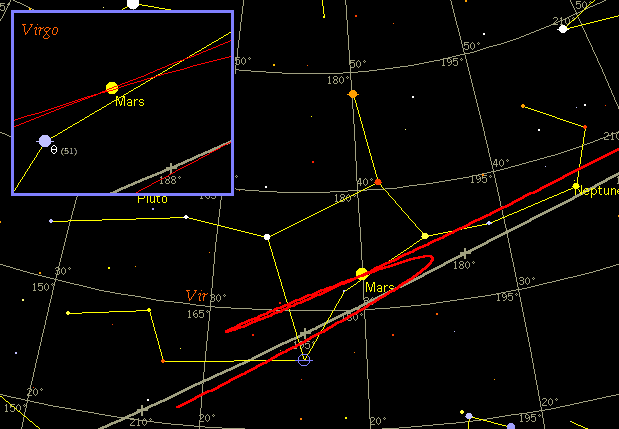
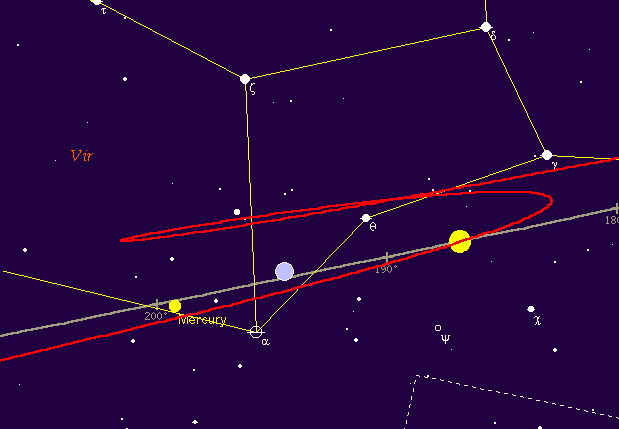
Starting from the previous September 21 of 1445, we see that there is a Mars/Jupiter conjunction in early constellational Leo. From this point, we can trace Mars’ track for the next year, up to September 21, 1446. We find that Mars went through a retrograde cycle as it passed through constellational Virgo, stationing in the figure both retrograde and direct, making three conjunctions with Spica, and also crossing its own south node as well, as shown in this next graphic:
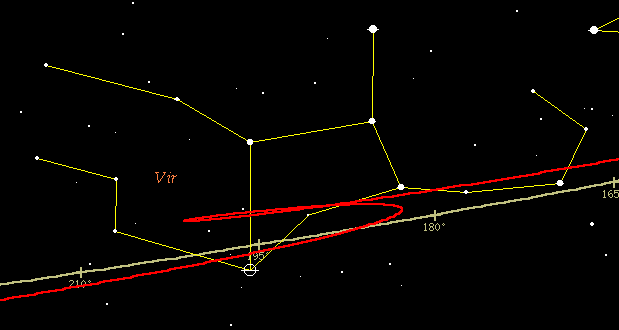
In all, Mars spends nearly nine months (early November 1445 through July 1446) transiting the stars of Virgo, suggesting again the concept of incubation.

Furthermore, we can identify the dates and positions of Mars and plot them on this track:

- Conjunction to Spica #1: January 15 1445/6
- Conjunction to Spica #2: March 14 1446
- Conjunction to Spica #3: June 25 1446
- Station Rx: February 14 1445/6
- Opposition to Sun: March 24 1445/6
- Station Direct: May 4 1446
- Passes own South Node: May 31 1446
On Christmas of 1445, two Mars-like events are evident. First is Luna co-culminating with the fixed star Antares, the alpha of Scorpio, which literally translates as “rival of Mars”:
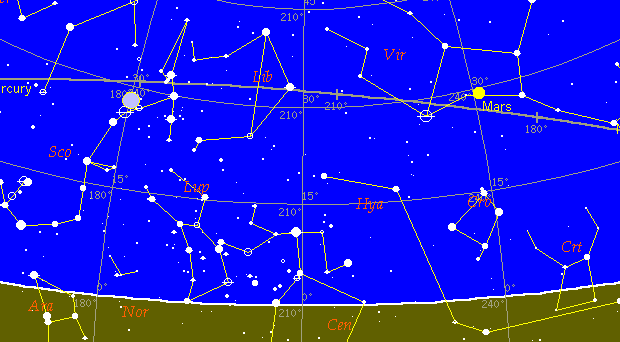
We can also see Mars in Virgo on the point where it returns to later when retrograde:
Mars, Luminaries, and St. John’s Day
On June 24, St. John’s Day, three planets are aligned with stars revered in Masonry:
- Mars conjunct Spica
- Jupiter conjunct Regulus
- Saturn conjunct Asellus Australis
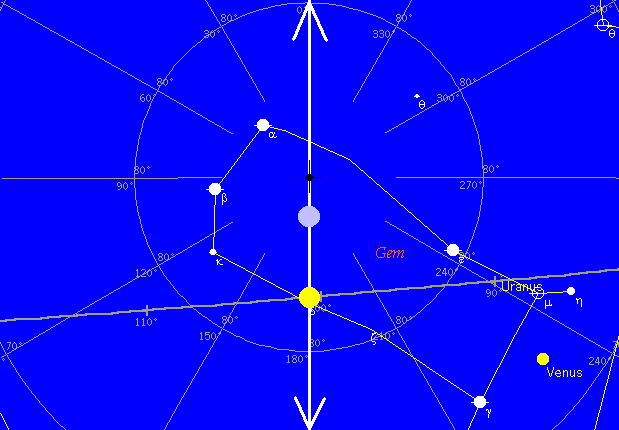
This while a new moon occurs occurs in Gemini, as seen in the next graphic:

This particular lunation, already “special” by forming on St. John’s Day, is tightly conjunct by azimuth over the sacred spot of Giza:
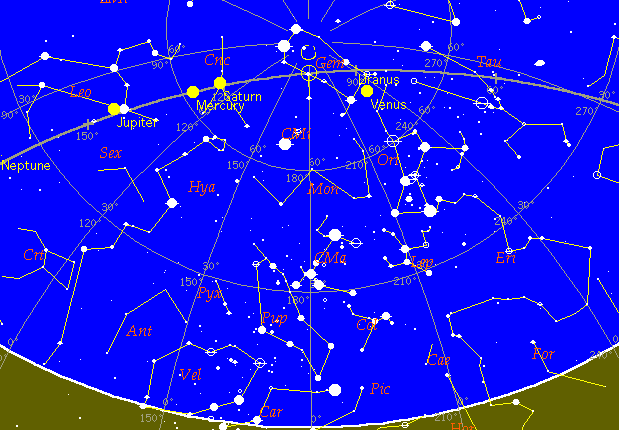
This lunation is exact to an amazing 13 seconds of time, as is depicted in the closeup sky chart, centered on the local Zenith:
- Sun culminates @ 11:58:15
- Moon culminates @ 11:58:28
Mars’ South Node
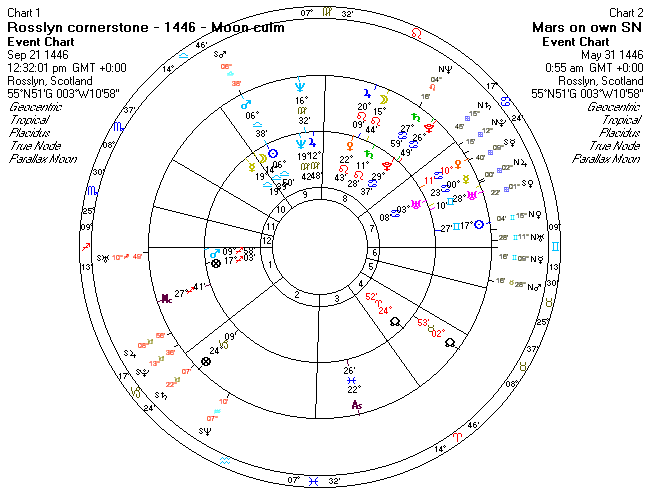
Further evidence of a Mars connection is Mars’ south node. As stated above, Mars crosses its own south node before making its third conjunction with Spica on May 31 @ the tropical longitude of 6°38′ Libra. This degree is indeed being transited on the 21st of September for the foundation stone ceremony, as is shown in the next two graphics:
Recent Evidence for Mars at Rosslyn
The Grand Lodge of Scotland at Edinburgh
It should be said that the Scottish realms were friendly to the (for lack of a better term) neo-Templars, and the Papal bull that outlawed the Templars was not enforced in Scotland. This allowed for the Templar traditions to survive, albeit underground, according to some scholars. Rosslyn’s place in the realm of the spate of Collegiate Chapel building is rather unique, but in all 42 such chapels were founded in the Scottish realm between 1248 and 1545. Even among the larger pantheon of mid-15th Century Christian masonry, Rosslyn stands as unique. It is easy to assume that the Scottish Masons as the forerunners of the Scottish Rite in America, but in reality this may be truthful in name only. A connection can be made from the later Sinclairs of the 18th Century to the sudden appearance of “Ancient” masonry in the Americas after 1750; tis infusion of masons that were not beholden to the Grand Lodge of England caused a schism in Freemasonry that lasted for decades until the Grand Lodges united.
We do know that a Sinclair was at the helm of the very first Grand Lodge of Scotland. As was cited earlier”
The founder of the chapel was Sir William St. Clair (Sinclair), third and last Earl of Orkney. He lived during the reigns of the Scottish Kings, James I, II and III, who gave to the St. Clair family the office of Hereditary Grand Master of the Order of Freemasonry in Scotland.
A later William St. Clair was the last to hold that title, and the last man buried in the vaults of the chapel. A member of Canongate-Kilwinning Lodge #2 and childless, he was instrumental in forming the Grand Lodge of Scotland. Unanimously elected the first Grand Master by the 32 Lodges meeting in Edinburgh on St. Andrew’s Day, November 30, 1736, he was succeeded by the Earl of Cromarty in 1737. “The Lodge of St. Andrew’s of Boston New England,” chartered by the Grand Lodge of Scotland on November 30, 1756, continues to meet in Boston.
Here we have a definite date for the lodge founding, and we can see that indeed Mars, Luna, and Spica are on the east and west horizon over Edinburgh for this date (December 11 in New Style format):

Of particular note is the fact that the midheaven of this chart is ~274° of ecliptic arc, or the degree of arc that the Sun transits on Christmas.
The Visitors Centre
Although the exact nature of what the Sinclairs were doing astrologically may be lost to history, we do have evidence from recent activity at that site which may offer some clues; that is, if we are to accept that some sort of secret tradition was being honored. The online edition of the journal Freemasonry Today gives us this interesting event:
On the 2 April 1998, H.R.H. Prince Charles [now King Charles] officially opened a new visitors center, housing not only an exhibition on the chapel but, in due course, a section dedicated to masonic and Templar aficionados, along with a purpose-built car park.
Such an undertaking would surely have to honor the traditions of the sacred site. Mars, as we will see, is a focal point of the astrology of this date for the locale of Rosslyn. Our first stop is Giza, where we see that April 2 of 1998 is the date when the Moon is conjunct the belt stars of Orion while simultaneously a mundo square of Sirius and Mars takes place with the smallest possible orb:
- Sirius rises at: 12:35:24 PM EET
- Mars culminates at: 12:35:15 PM EET

A closeup of Mars on the meridian:

Recalling that at Giza, when Sirius rises, Spica is at the nadir, we can conclude that Mars, conjunct Saturn, is opposite of Spica @ 23°49′ Libra:
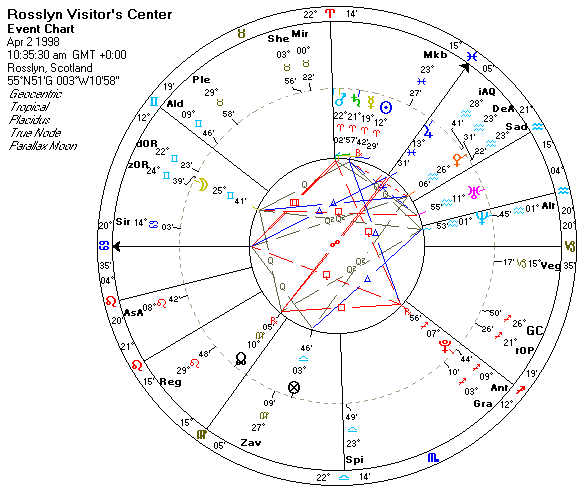
When we relocate this chart to Rosslyn, we find that Jupiter is culminant, but more importantly we see the Markab, the corner of the celestial square, is exactly on the meridian!

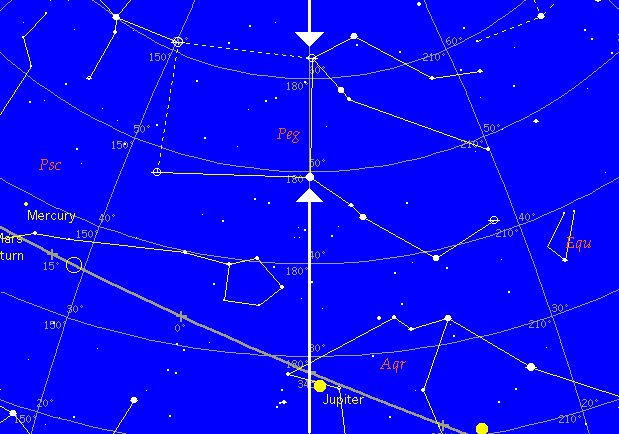
Such a precise alignment is not possible on any other date, and we have to see that such precision was foreseen and employed in an electional sense for this event.
But, why use a Mars/Saturn conjunction, which is viewed as highly unfortunate in contemporary astrology? Perhaps it has to do with the track of Saturn in 1450 that takes a similar trek to Mars’ path of 1446:


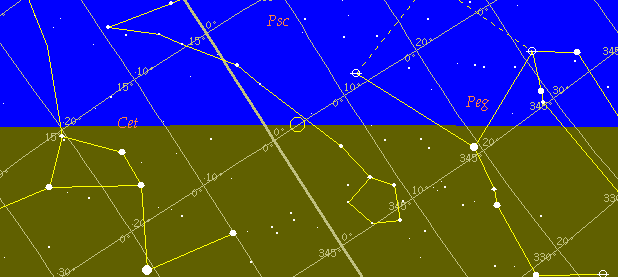
The final consideration is that Luna sets over Rosslyn while exactly on the 0° Aries point, as shown in the following graphic. The Moon, as a reflection of the Sun, is at the opposite nodal point from autumnal equinox. This would show some reverence for the cardinality of selecting September 21 in the first place.
-Ed
1 Atlantis Rising, March-April 2003, p. 42.
2 Robson, Vivian, The Fixed Stars and Constellations in Astrology, Samuel Weiser Inc., New York, 1923, pp. 211-2.
3 Gettings, Fred, Dictionary of Astrology, Routledge and Kegan Paul, London, 1985, pp. 344-5.
4 Olcott, William Tyler, Star Lore of All Ages, Kessinger Publishing (reprint of 1911 edition), Montana, USA, pp. 381-3.
5 Ibid.
6 Bullinger, Ethelbert W., The Witness of the Stars, 1893, p. 33.
7 Allen, Richard Hinkley, Star Names, Their Lore and Meaning, Dover, New York, 1963, pp. 462-3.
8 A better translation may be: “The laughter you may hold friendly.”
 Emersion: A Blog from Occursion Media on Somewhat Interesting Hidden and Cryptic Astrological Histories
I read this post on Oct 3 2023 as Mars is conjunct the South Node and Eris conjunct the North Node at 24˚ Aries/Libra
The degree of the Nodes in the Rosslyn Chart
How interesting is that?
Onwards 🙂