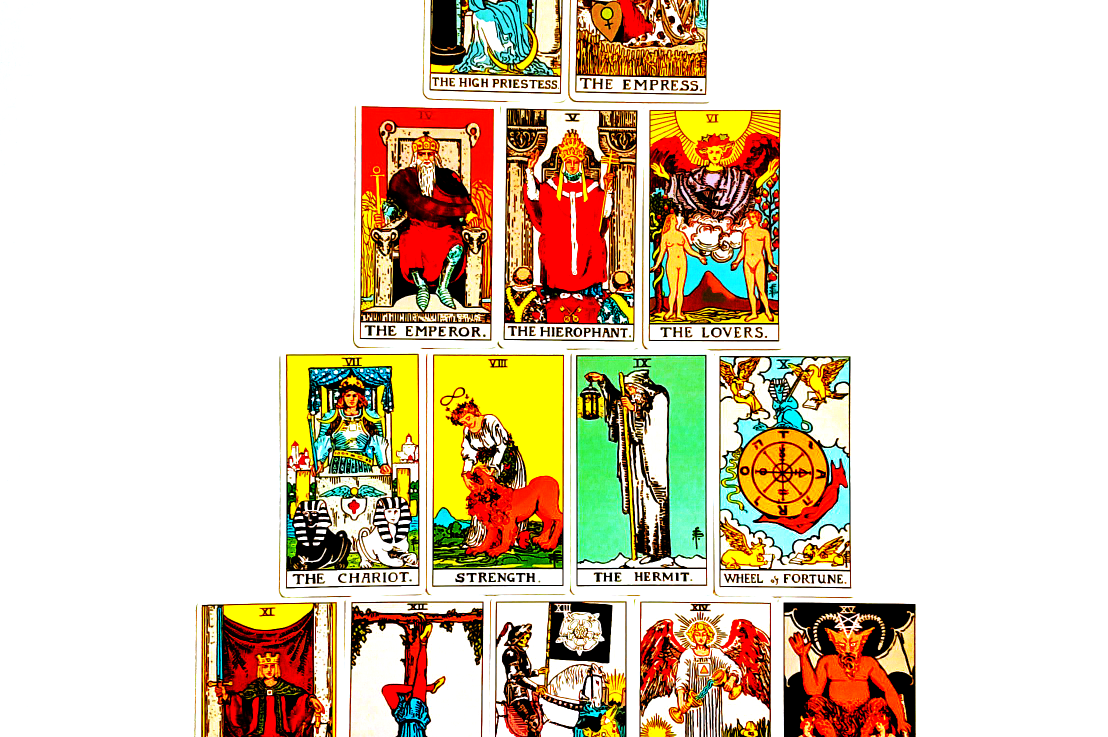
When I finally got around to studying and dissecting the tarot years ago, I thought it would be somewhat simple. As an astrolo-phile, it was necessary to understand it, not because I wanted to do tarot readings at the local bazaar, but because the occult-minded mentors I knew used the tarot as a sort of sister tool of divination.
Of course, what I did learn is that there is nothing simple about the tarot. In actuality, it has multiple “occult” facets operating simultaneously, and the deeper I went, the more fascinated I became. The tarot may be many things to many people on a cursory level, but it offers a level of occult and symbolic sophistication that rivals anything else, such as runes or even the I-Ching.
In short, the cards are more than just a handy little medium for fortune-telling. Rather, they are a codex of Renaissance-era cosmology that reveals itself to the seeker in so many “a-ha” ways. It is quite the genius invention, and I’m sure I’m not finished finding all the goodies.
In the first three parts of this series, we began by asking the simple questions of why the three astronomical cards are contiguous and also why they are in that part of the sequence and not some other parts. As it turns out, that was a good place to start.
We learned that some special mathematical “things” were going on, with both prime numbers and the so-called Fibonacci series – related to the Golden Mean, or “phi” – and then the concept of “pi,” or the ratio of a circle to its diameter.
In this part, we will look at a third numerical sequence, which should tie everything together.
21 and Triangled Numbers
Between the idea of a straight line and a square lies the form of a triangle: a line has two points, a square has four points, but a triangle has three, and three is where our idea of “form” begins.
Square numbers are ubiquitous in mathematics, for obvious reasons, such as, “How big is my farm?” and “How much carpeting do I need for my house?” Most of us have houses that are assemblages of rectangles, but few of us have triangle-shaped floor plans, or triangle-shaped farms, so the practical knowledge of figuring out how much area a triangle might have is almost moot.
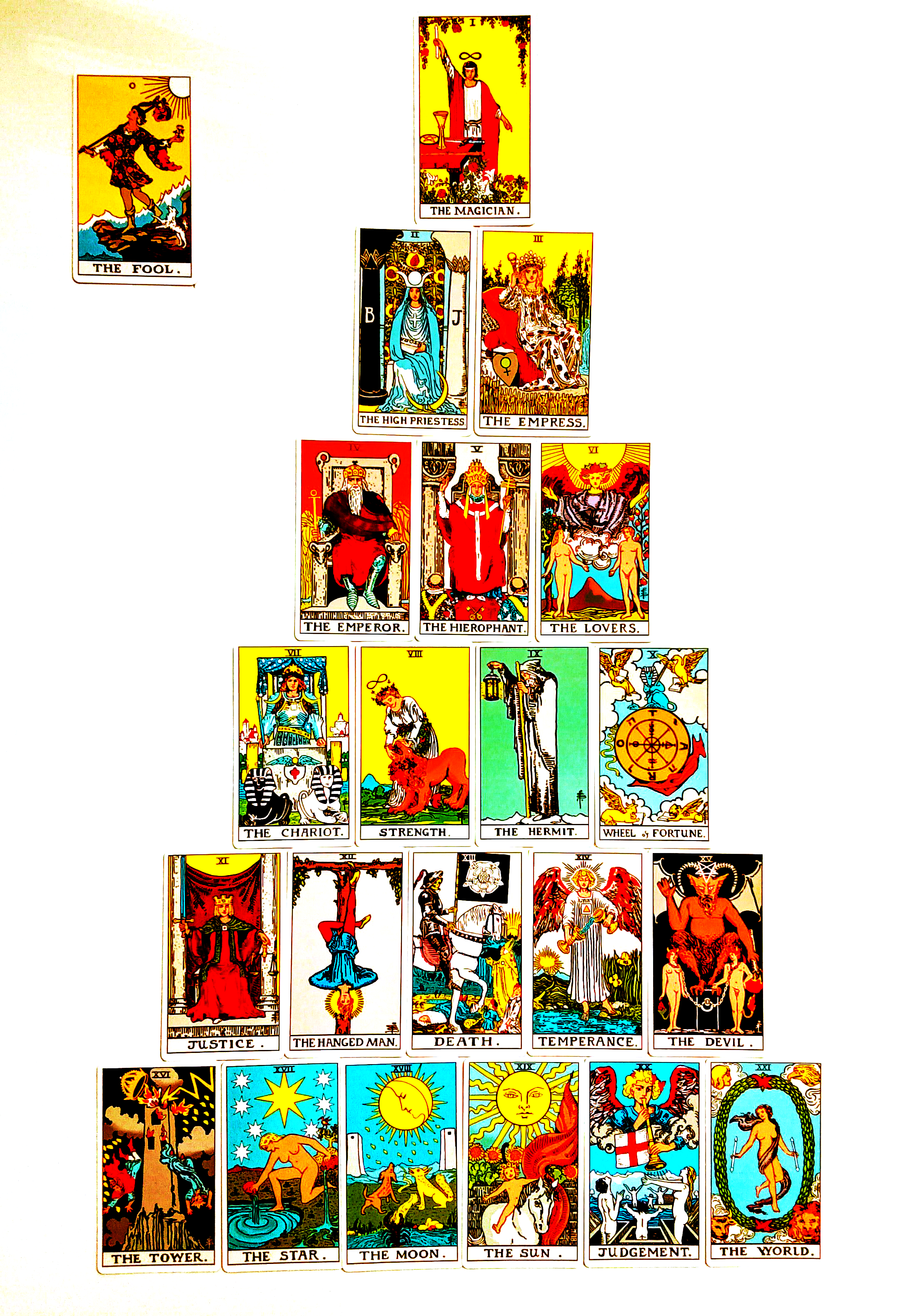
However, the divine stories tell us of a triune “god,” and so the triangle was a bit more obsessed over in the old days. Remembering that our “major arcana” is either 21 or 22 cards, depending on how we count, we can arrange the 21 non-Fool cards in a tidy triangle with three equal sides of six cards:
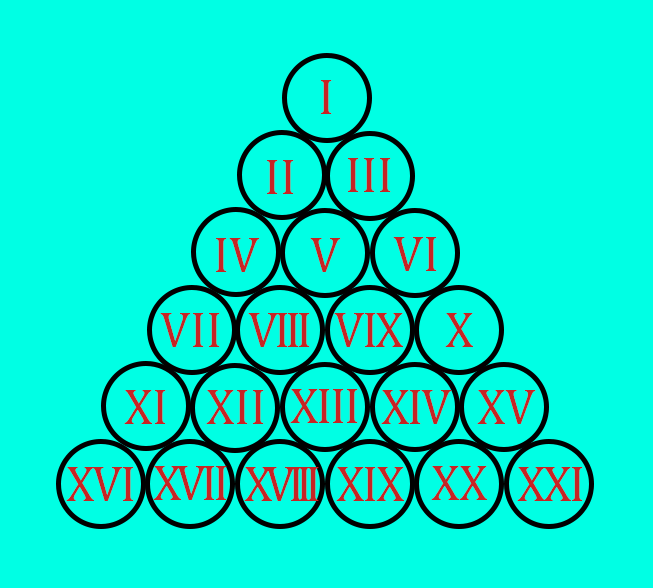
Simplified, we can see it like this:
There is a sequence of triangular numbers, and here it is. Notice that 6T gives us the number of cards in major arcana sans The Fool, while 12T gives us the total number of cards in the deck – 78:
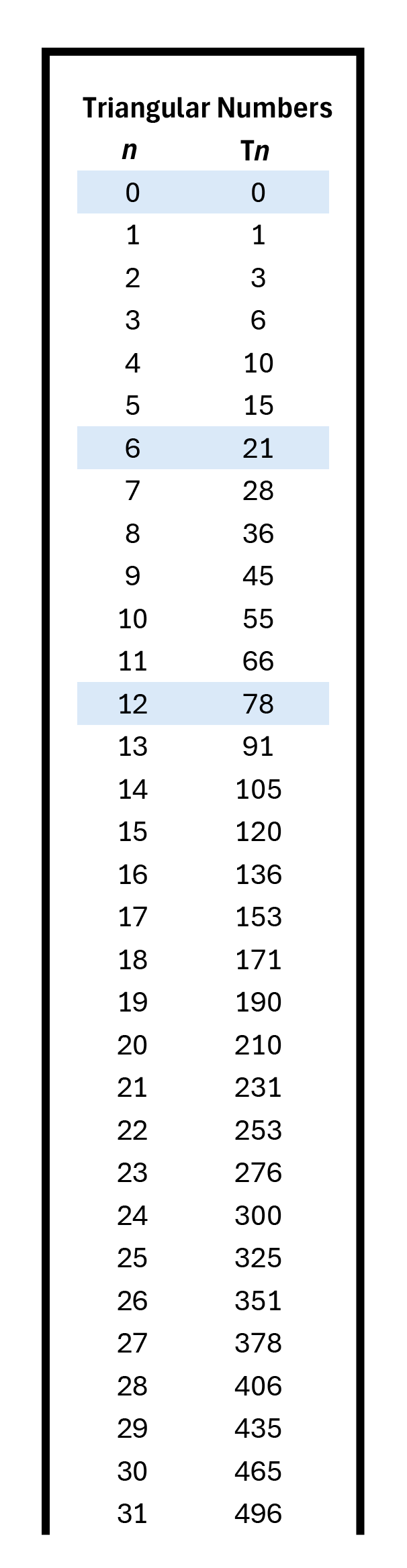
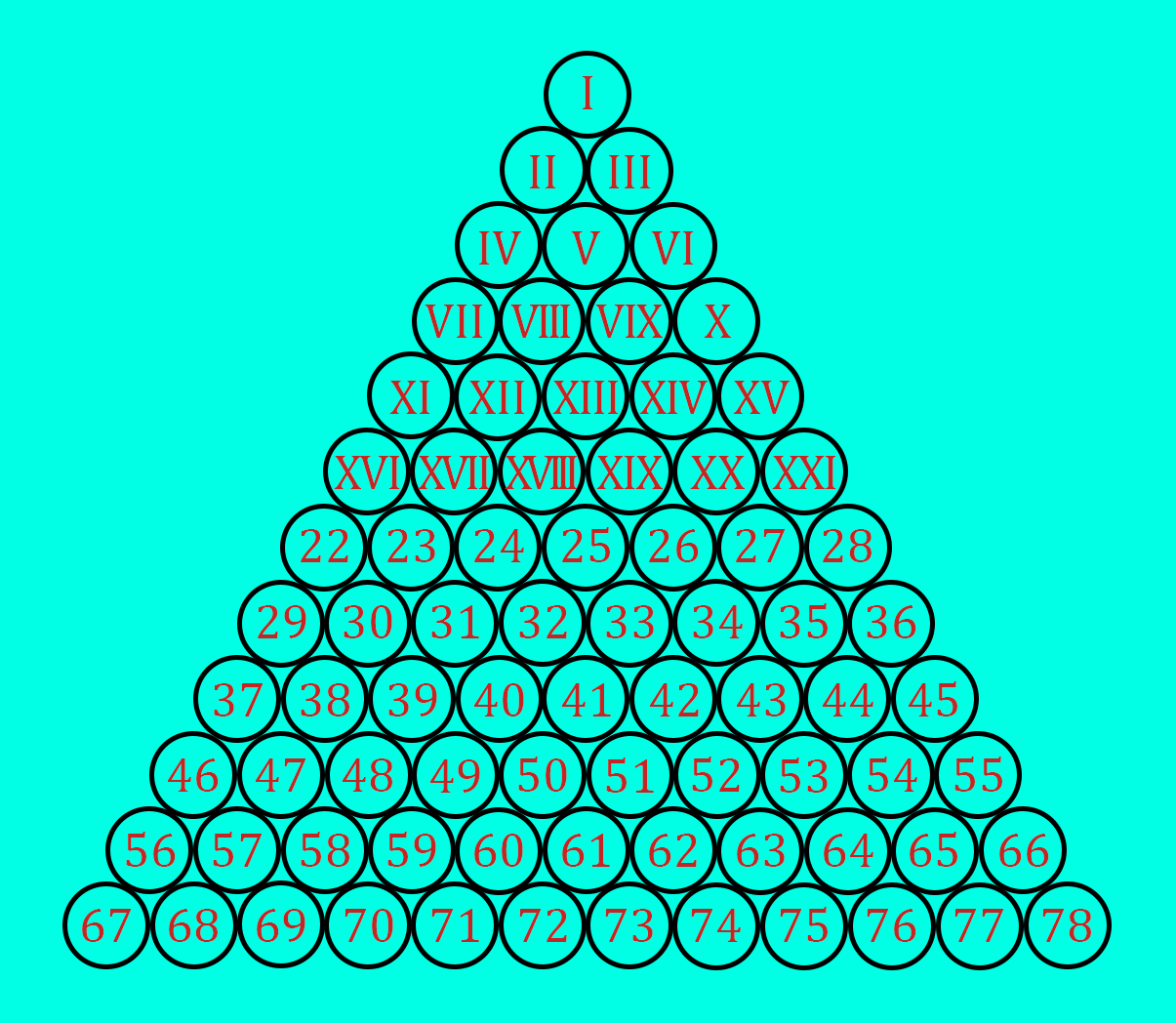
Clever, eh? Triangled numbers offer us one more portal into the number magic of the tarot.
The number “21” exists both in the Fibonacci sequence and the Triangled number sequence. Is it clearer, now, as to why “The World” is card #21? While 21 is not a prime, it is, as discussed in Part I, the product of two prime factors: 7, and 3. There is no other way to get to 21 than 7×3. (The value is also prevalent in 52-card Blackjack, where 21 wins but 22 busts.)
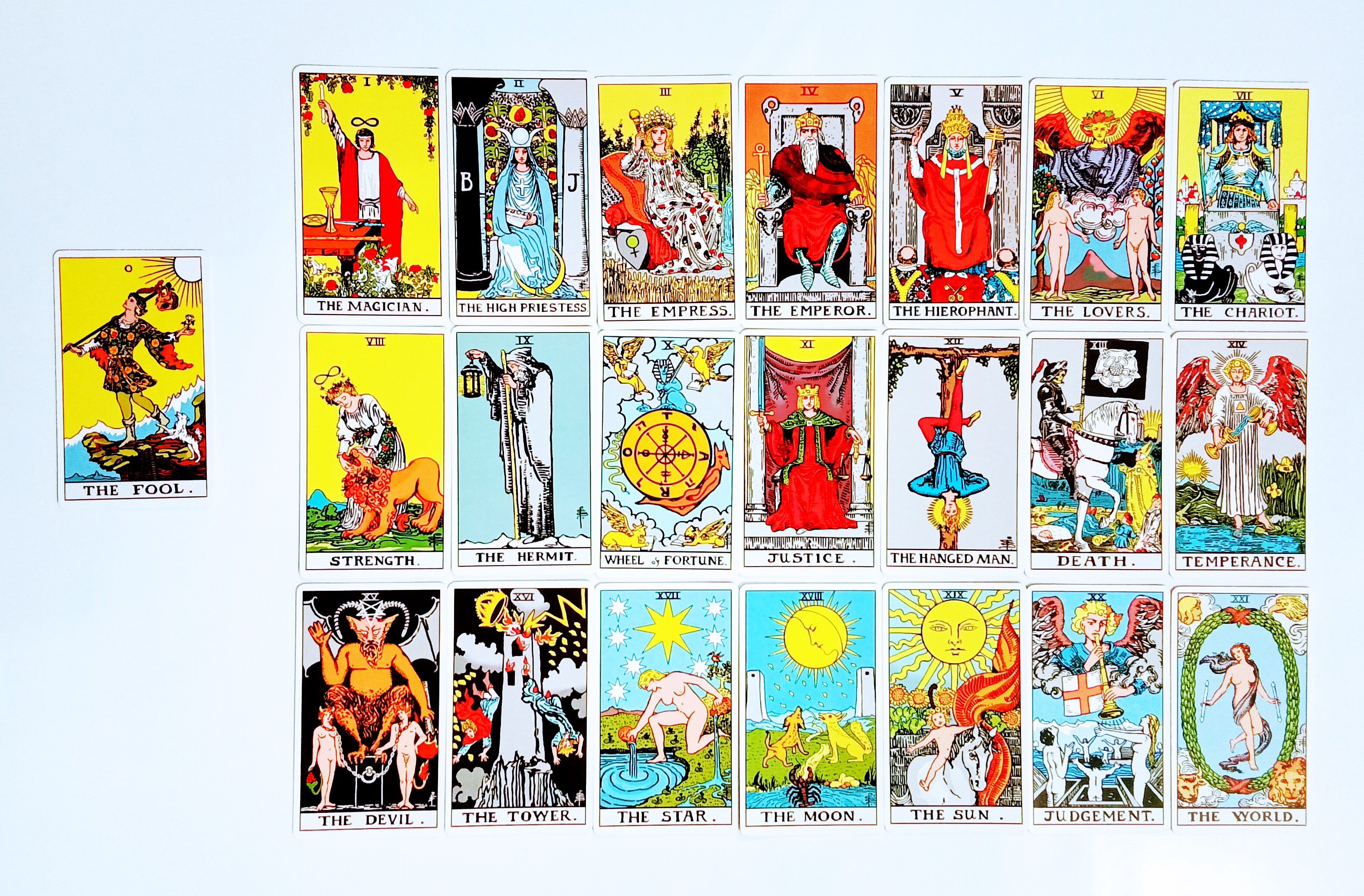
We can arrange the deck in a 7 by 3 rectangle to make triplicities easier to see, with the caveat that the Waite sequence switches Strength with Justice. Do the vertical triplicities bear any kind of relationship to each other? The sacred math tells us they should.
To put this in more perspective, we can compare and contrast all three number sequences to see which ones contain the same numbers. (I’ve listed them in four different ways, just for demonstration.) In this sense, the numbers 13 (Death) and 21 (The World) hold special significance, and therefore an occult connection:
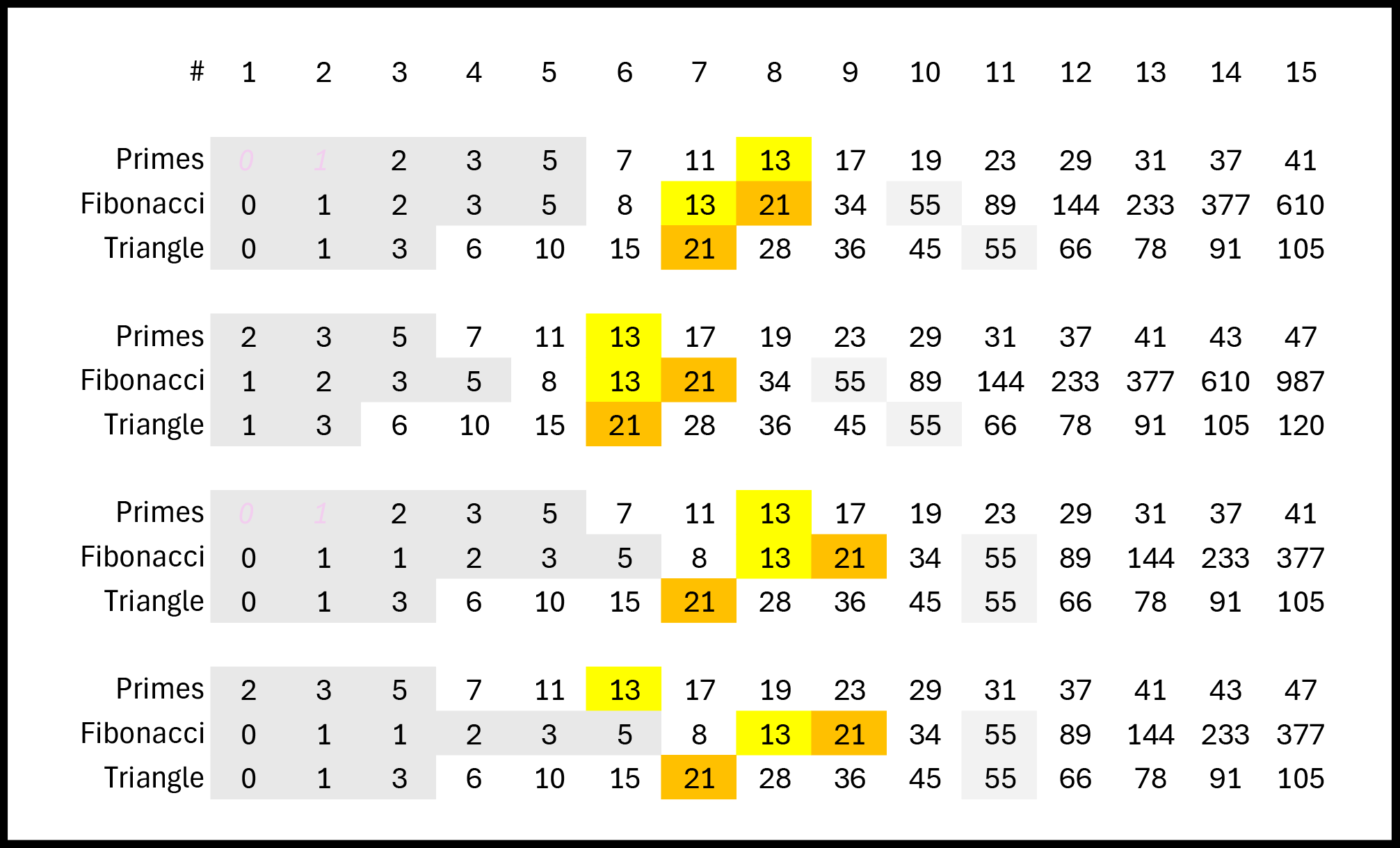
(Note that “3” is the only number common to all three sequences.) Referring back to the top graphic, a vertical line through the center of that triangle touches three cards: The Magician I, the Hierophant V, and Death XIII. The Magician is the creative force; the Hierophant is the portal to life beyond death, and Death is, well, Death, though through Death we return to the original place of creation.
Returning back to our foundational prime math for the deck:

The prime factorization matrix of the deck involves 2, 3, 7, and 11, with the 11 factoring into either the major arcana plus The Fool: 2×11, or the major and minor arcana minus The Fool: 7×11.
22 = 11 × 2
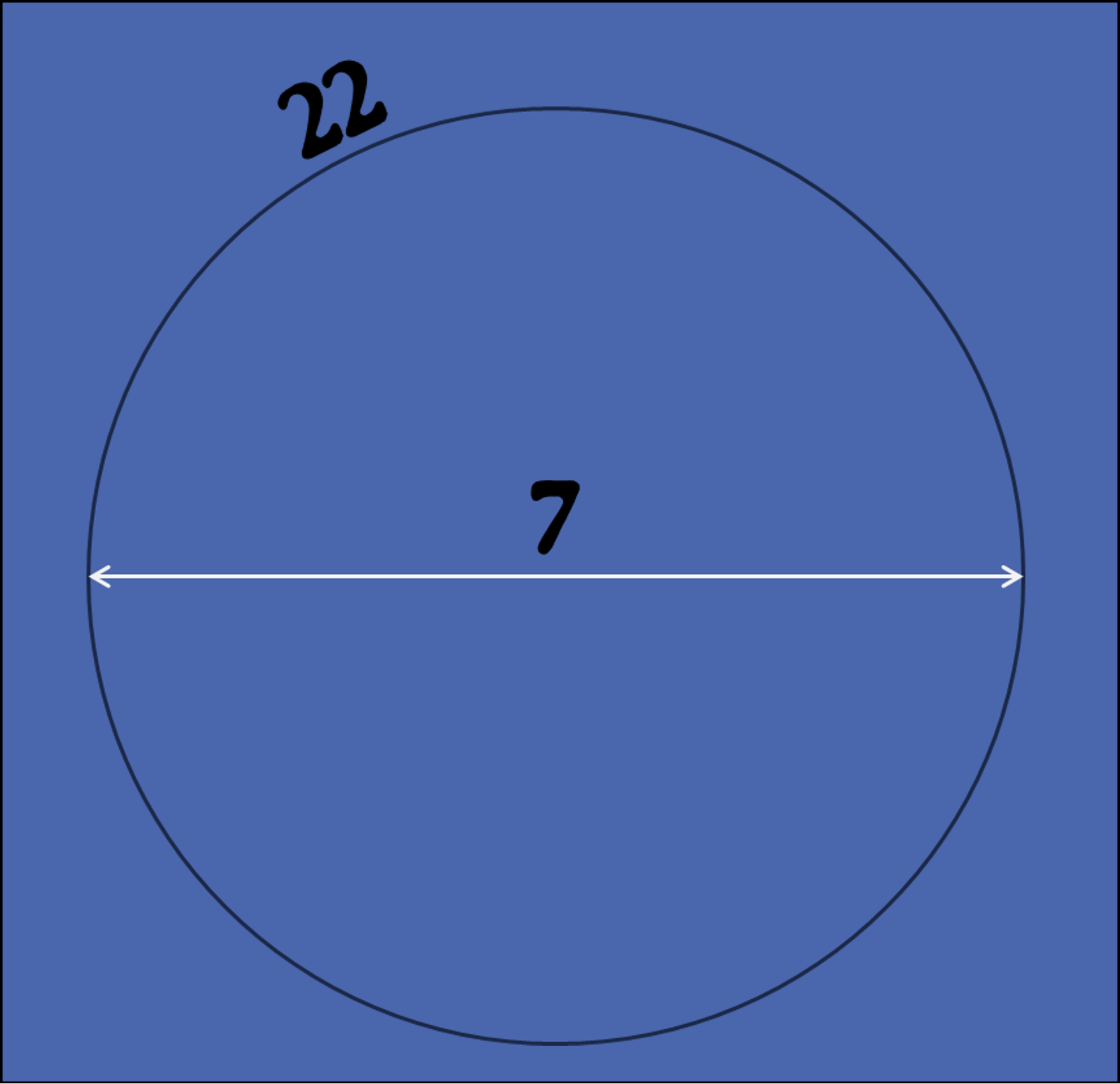
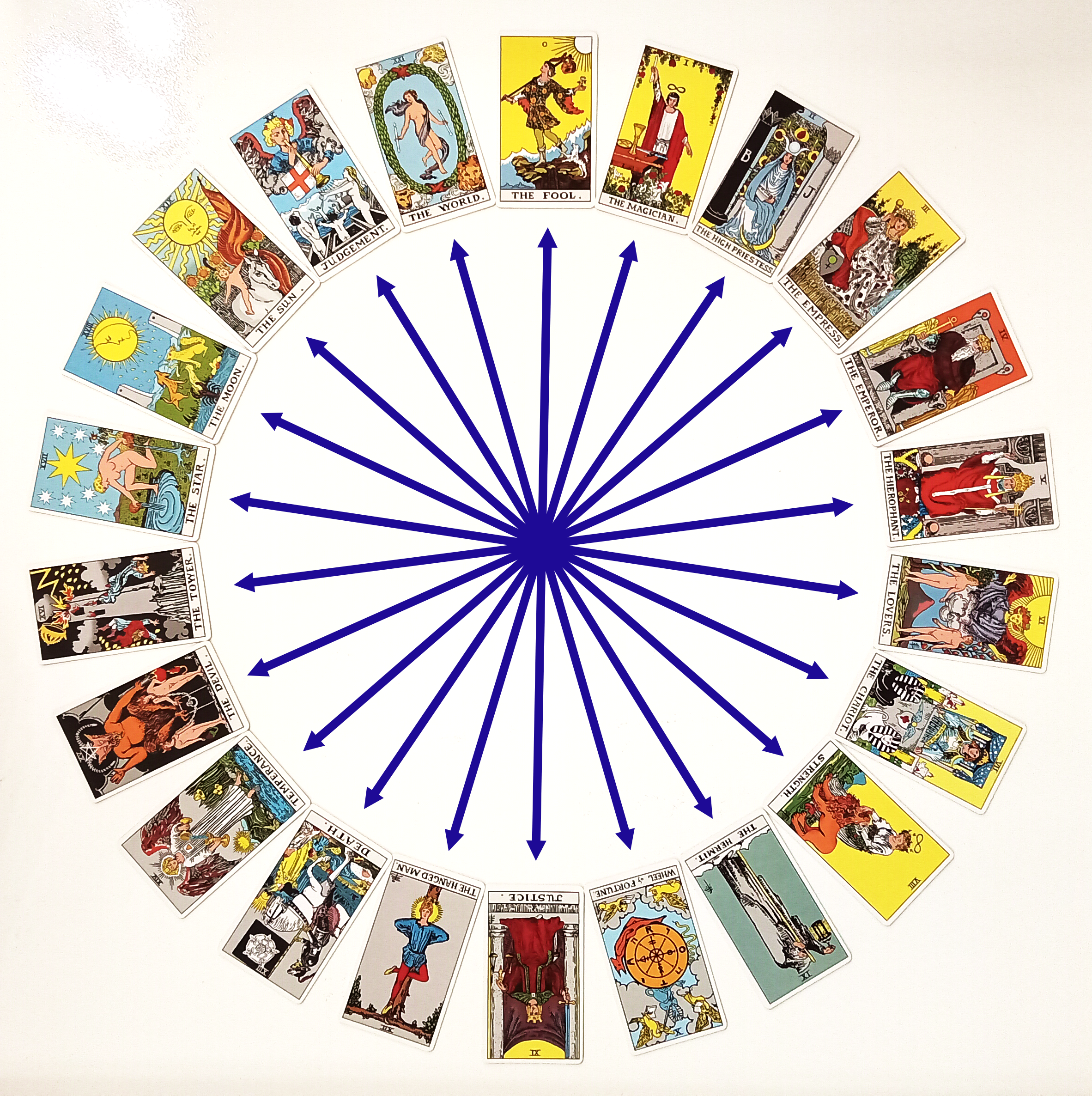
As noted in Part I, the old-school approximation of π is 22/7, and the tarot deck is definitely implying that we should arrange our major arcana in a circle. As 22 is only divisible by 2 and 11, we might surmise that each card has a counterpart. To find it, just add or subtract 11.
The array with Waite’s ordering:
The traditional sequence:
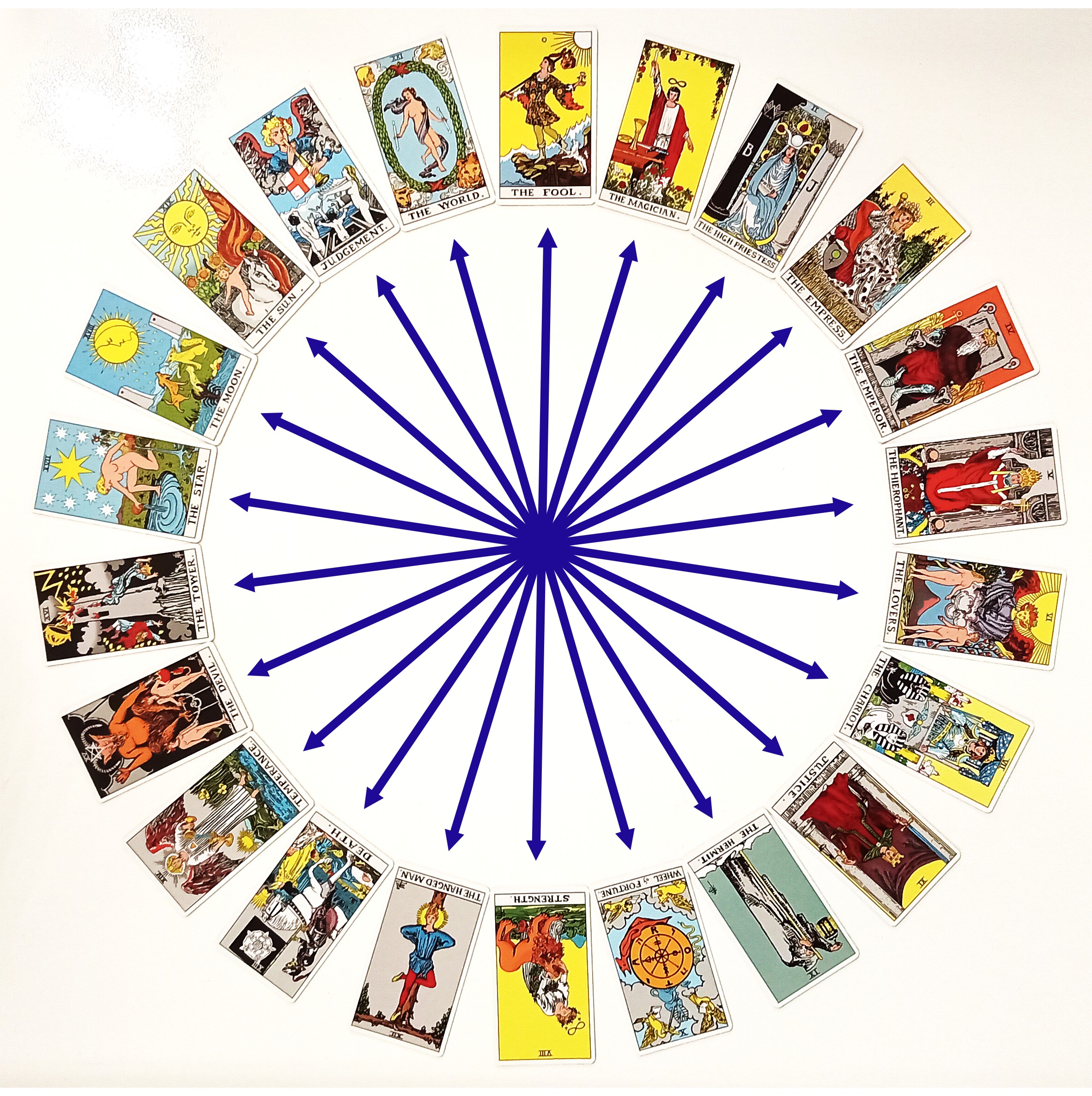
The switcheroo with Justice VIII and Strength XI may explain why Waite, if he too thought of the 11/11 polarity as valid, altered the order, to align The Sun opposite the card with the lion on it. Leo – the Latin word for lion, ruled by the sun, should be a counterpart with The Sun XIX, duh!
However, looking closer within the actual scheme, this seems to be another one of Waite’s follies. The Justice card should be opposite The Sun, and numbered VII. The scales in the motif represent Libra, the zodiac sign opposite of Aries where the sun is exalted (and one reason why that card gets the number 19). Ptolemaic dignities and disabilities of planets tell us that the Sun is in its “fall” in Libra, because Libra is opposite of Aries. Saturn is “the law,” and Saturn’s exaltation sign is Libra; Saturn is always furthest from the sun.
The figure holding the scales is also holding an upright sword in the right hand, a counterpart to the meting-out of justice, yes, but also a symbol of Mars, the ruling planet of Aries. So, with all due respect to the Waite acolytes, his alteration to the order was anything but an improvement.
The Sun and Justice are symbiotic ideas in other ways. The sun helps us see things, “sheds light on things,” but it also can blind us, as in “blinded by the sun.” The sun is the enemy of darkness, of our fears and the unknown, but our modern symbol of justice is that of a blindfolded woman.
As for Strength being the counterpart of The Fool, this would imply that The Fool lacks strength in and of itself, and that is mostly true as a zero, with only the potential to be the most powerful card in the deck once it attains the value of another card.
Summarizing, the major arcana function in the triangular and the circular, with 7 as a common divisor:
21 = 3×7
π = 22/7
Other Triangle Math
The Triangle numbers listed above are for equilateral triangles, but there are other kinds of triangles:
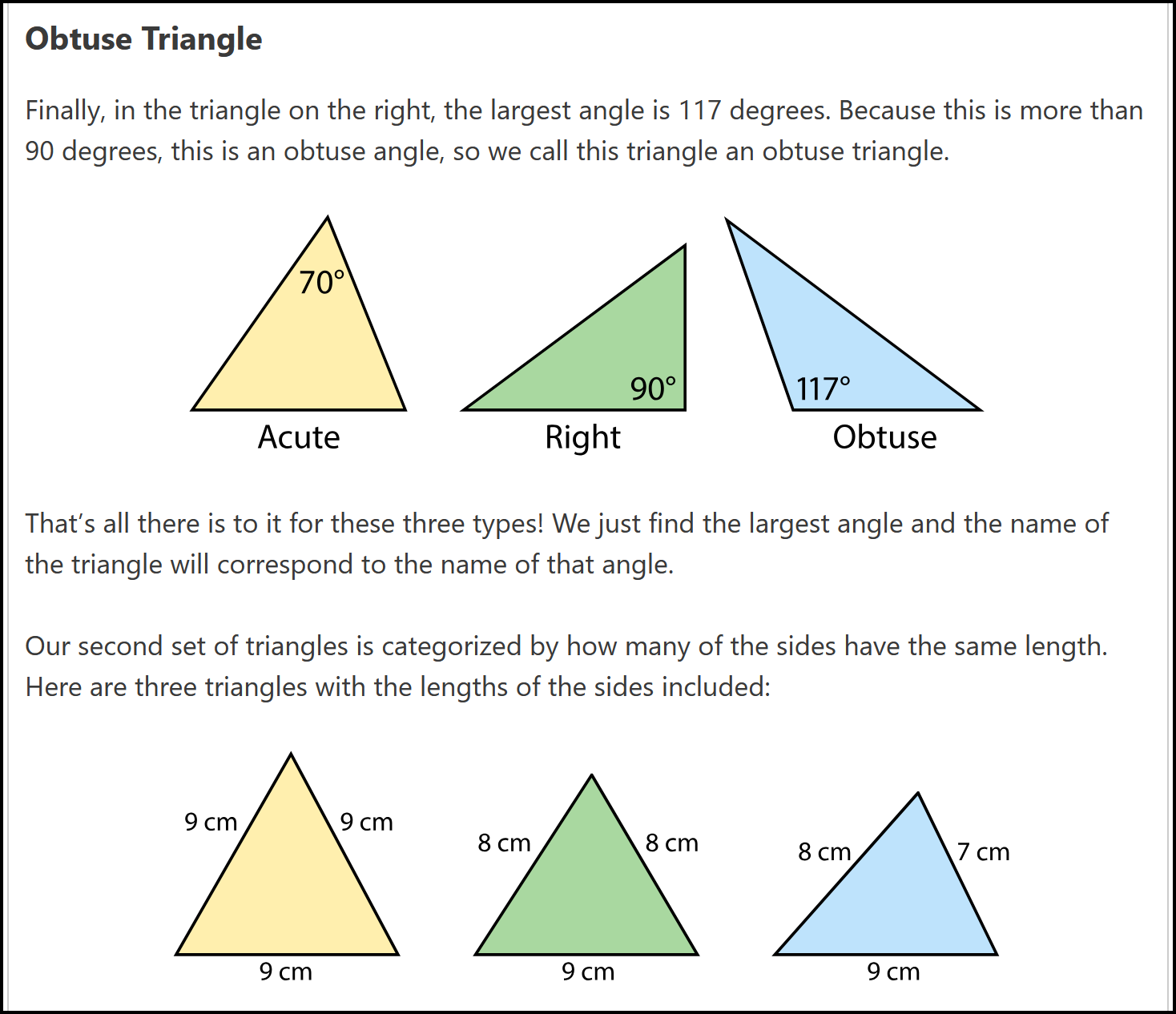
We are only interested in the equilateral triangle, for now. The formula to determine the area of an equilateral triangle is as follows:
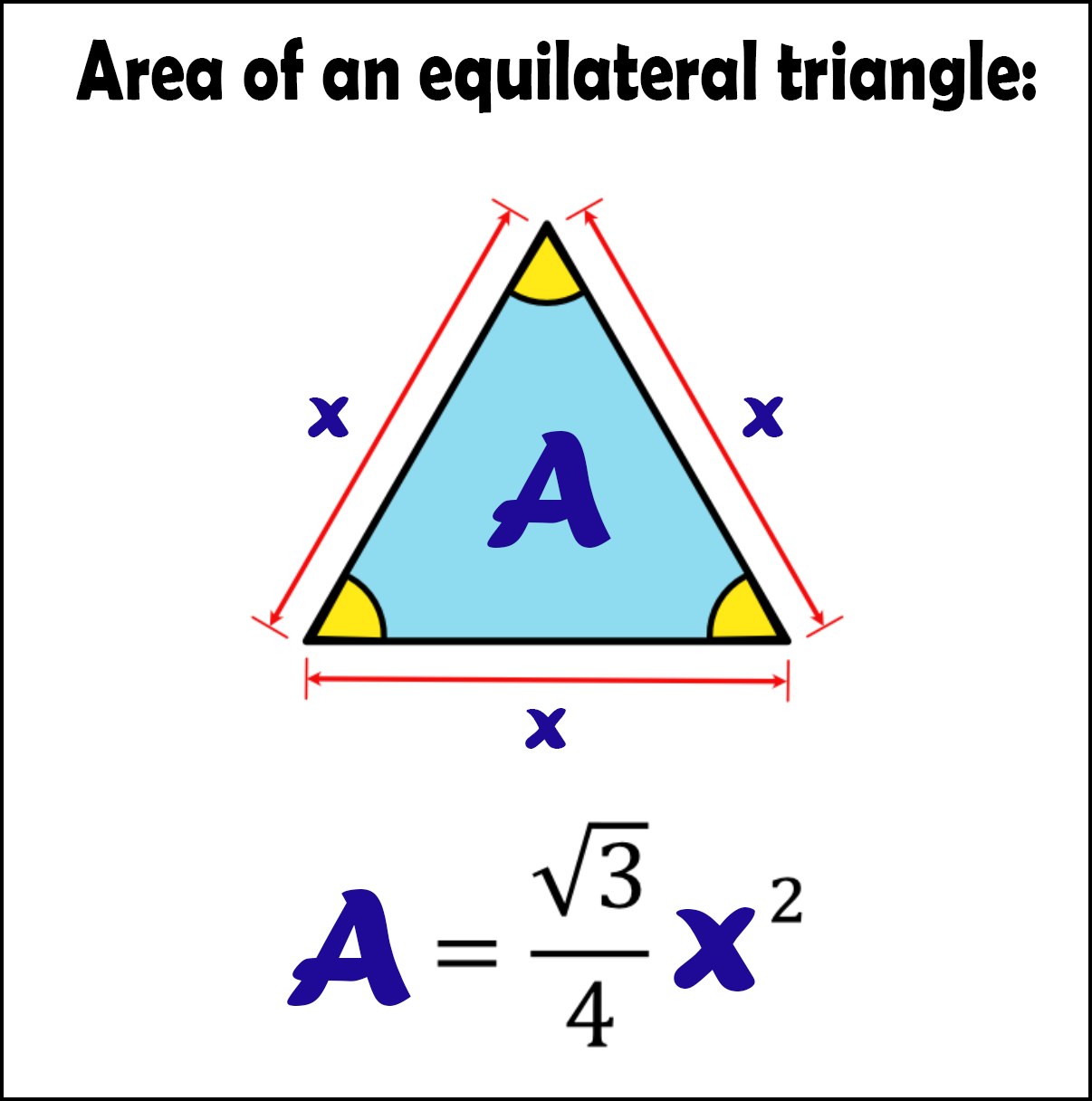
The constant of root-three over four is an irrational number:
0.43301270189221932338186158537647…
but it can be approximated to 0.433, which makes our math a tad more streamlined. For instance, to find the area of a 3-3-3 triangle, we just need to take the square of 3, which is 9, and then multiply that by .433, yielding an area of ~3.879.
Our tarot deck wants us to find the areas of a 6-6-6 triangle and a 12-12-12 triangle:
62 × .433 = 15.588
122 × .433 = 62.362
Those areas, when added together, are:
15.588 + 62.362 = 77.94
Which we can see is a hair under the number 78. Remarkable, no?
The Vesica Piscis
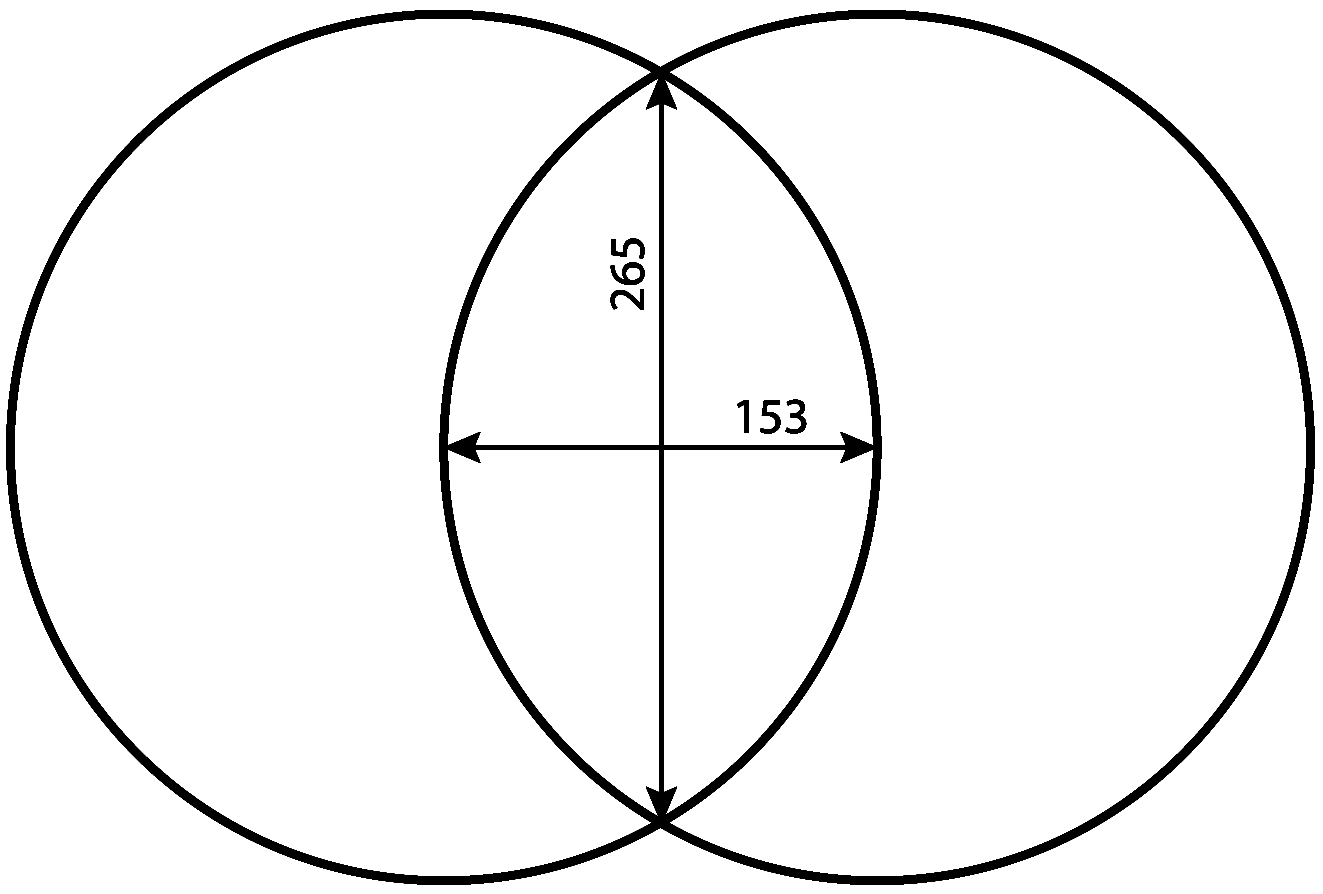
The Triangle number for 17 is 153. The 153 has special characteristics, and is even mentioned in the Bible – the book of John’s miraculous catch of 153 fish. 153 is part of the approximate ratio of the Vesica Piscis, which is shaped a bit like a fish:
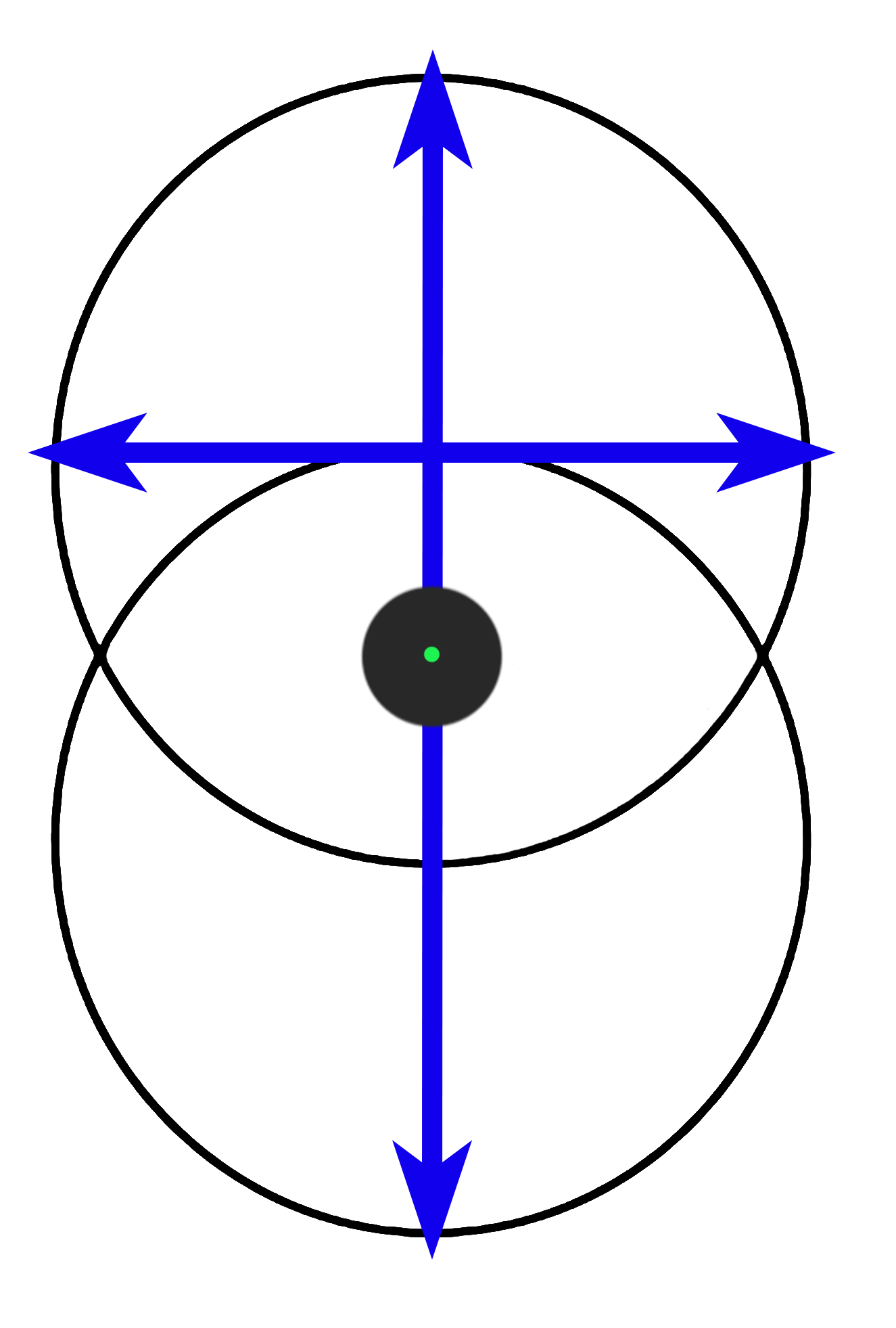
It is also argued that the basic dimensions of the Latin Cross are based on the radii of these overlapping circles:
And certainly this is the underlying shape of the Christian “fish symbol,” the ichthys:

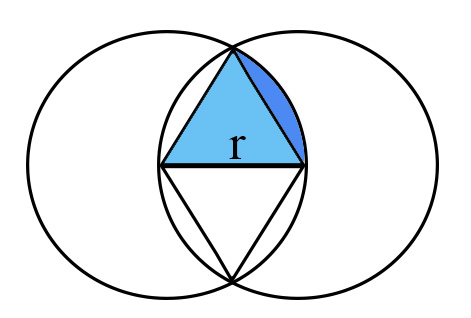
From there, we can see two equilateral triangles inside the VP:
And so ends this minor foray into sacred geometry. There is one more thing I’d like to mention, and it has to do with *gasp* 9/11. It is perhaps somewhat forgotten that then-President George “Dubya” Bush was in Florida that morning, innocently spending time with some young black students in an elementary school. Bush was told that something happened at the World Trade Center when he arrived, which we now know was Flight 11 smashing into one of the WTC’s Twin Towers (a giant 11).
Bush then proceeded into a classroom where they were using a textbook called Reading Mastery: Rainbow Edition, Level 2, Storybook 1. Bush picked up a copy and pretended to give a shit, and then was informed that Flight 175 had smashed into the other WTC tower, and that there was an actual “terrorist” event in progress.
The specific story in that book they were reading is entitled “The Pet Goat.” The story begins on page 153:
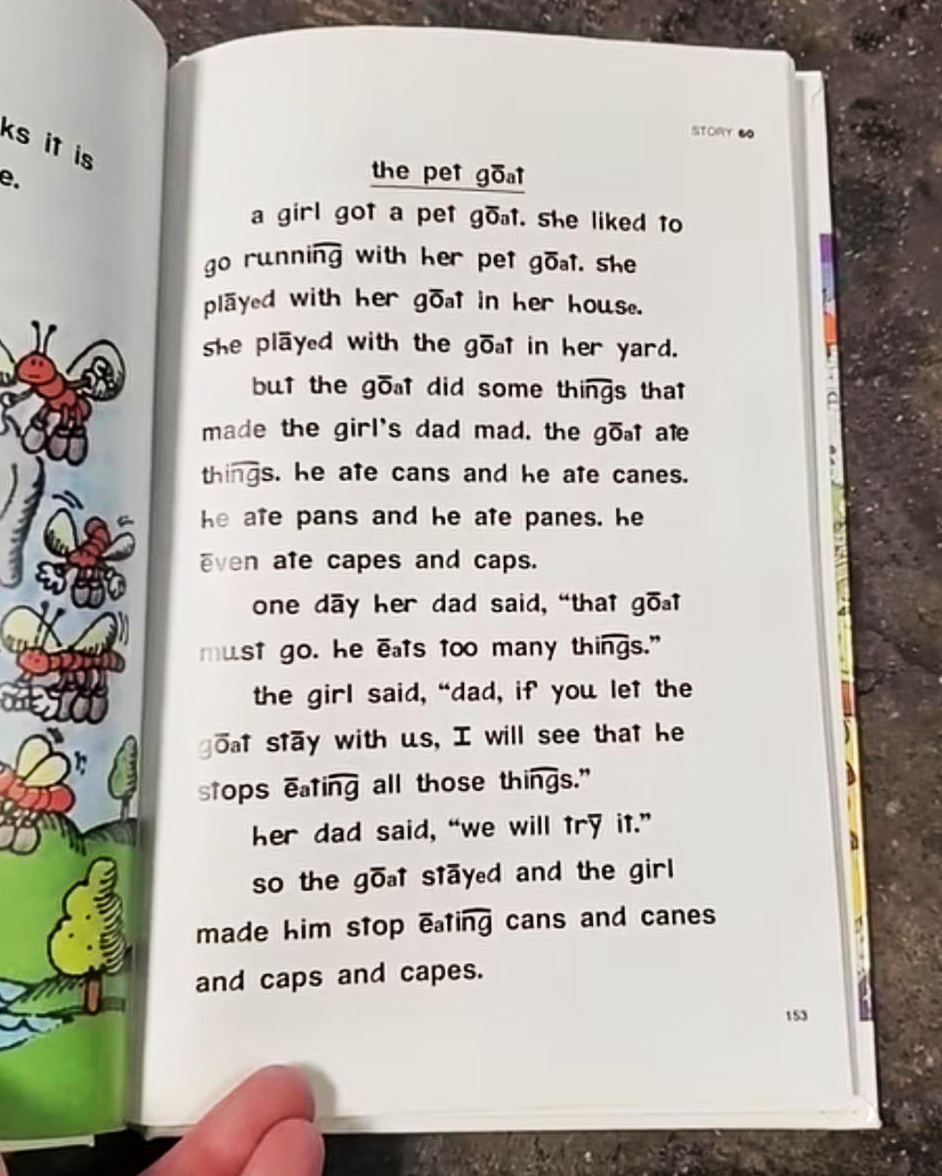
What can be said about this? For one, the goat motif in the tarot is the Devil XV card, and the following card is The Tower XVI. The next card is of course The Star XVII, which we now know is Venus, and the tarot is impels us to see the triangular number for 17 is 153. And … the number 175 is a Venus number as well, but in the realm of Magic Squares, where the “magic constant” of that matrix is 175:
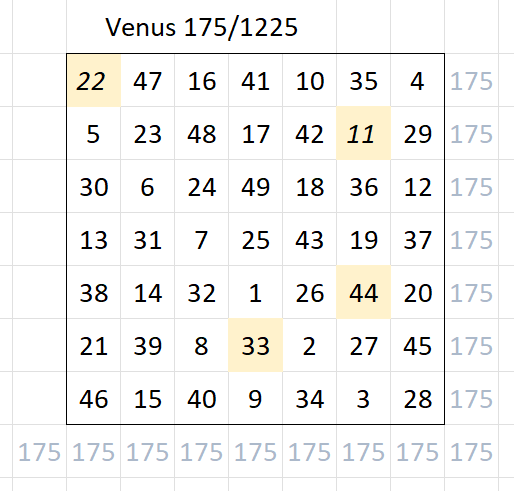
All of that is just coincidental circumstance, though, correct? Hey, the truth is stranger than fiction, but there’s never been a doubt in my mind that 9/11 was staged political theater.
What about the rest of the deck and the rest of the astrological elements?
I’ll get to that in Part V of this three-part series. The entire zodiac is accounted for, but will it be a fool’s errand?
-Ed
 Emersion: A Blog from Occursion Media on Somewhat Interesting Hidden and Cryptic Astrological Histories
2 thoughts on “Astrological Elements of the Tarot (no, not what you’ve read before) – Part IV”