I Part I, I tried to make a cursory case for 2ASO having some kind of affinity, or at least a nod, to the “Queen’s Conjurer” of the 16th Century – John Dee. This Dee-ist film reverence may have been prompted due to another contemporary film and character – James Bond – who was given the code of “007,” or “Double-O-Seven,” as the dialog repeats, which was the secret code used by Dee in his correspondences with the monarch. “Oh Her Majesty’s Secret Service,” indeed!
Why did Dee settle on “007”? Were the 00s really two zeroes? Was the 7 really a seven, or something else? Heck if I know, but let’s not get too far afield here. As far as I can tell, Bond never went to other planets, and 2ASO is all about going to other planets.
“God’s Longitude” and Dee
Dee was an astrologer, yes. And, Dee was also a kind of Time Lord. It was Dee who led the effort for calendar reform, and put forth a more accurate calendar that used a 33-year “leap-year” cycle that minimized “jitter” between calendar dates and the astronomical phenomena of the Sun-Earth nodes, more commonly known as the equinoxes.
Dee realized that a leap-year scheme of 33 years, with a leap day inserted every 4 years for the first 28 years, and then a leap day after 5 years, after which the cycle would repeat into perpetuity. It looks like this:

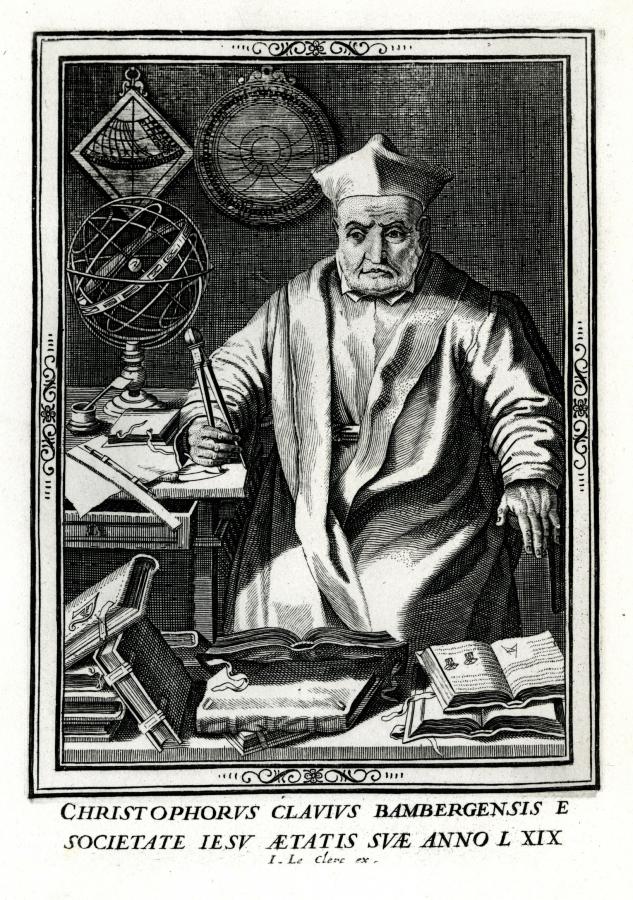
Dee’s system was rejected by the Papacy, who instead went with the suggestion of the Jesuit Christopher Clavius, and that is how we got the Gregorian Calendar that has a leap day inserted every four years, except for years that have two zeroes at the end, with the exception of years divisible by 400. (That is why the year 2000 was a leap year, but not 1900, 1800, or 1700.)
Thus, the Gregorian scheme inserts 97 leap days during a 400-year cycle, while Dee’s scheme inserts 96 leap days over 396 years. It’s like cutting hairs, eh? Well, there is a notable difference in one sense, and any astrologer who has calculated a solar return for the 33rd year of life has noticed that the angles of that return chart are nearly the same as the natus.
The practical value of the Dee scheme is that “jitter” thing, therefore, was that the clergy could be confident that any spring equinox would occur within a 48-hour variance, AND, that, at a certain earthly longitude, always fall on either March 21 or March 22. That longitude happens to be 77° West – the longitude of the USA’s Federal City, now known as “Washington D.C.”
Thus, 77° West became known as “God’s Longitude.” It should be noted that 77° West is almost exactly 90° west of Rome’s longitude.
But, what does any of that have to do with this frickin’ Space Odyssey film? It’s all in the numbers – the calendar numbers.
Calendar Numbers
Calendars have always been tricky things. How many days in a year? How many months in a year? How many days in a month? And, what the heck is a “day” anyhow? None of the answers involve integers, and all are fractions. A year is ~365.2422 days. A lunation, or “moonth,” is ~29.53 days. Thus, 12 lunations happen in 354.367 days, ~11 days short of a standard 365-day Roman calendar year,
So, over 3 years, a shortage of 33 days happens, and a 37th lunation will happen before the end of 1,095 (365 × 3) days. The ancients who obsessed over this kind of thing were well aware of this, but they also knew that 235 lunations would almost perfectly fit into 19 years. Since 12 × 19 is 228, it was simply necessary to add a thirteenth month in seven out of those 19 years.
AND, as it happens, if we simply count every 12 lunations as one “lunar year,” we find that 34 of those will occur in 33 Roman calendar years, with a handful of days to spare.The math is like this:
365.25 × 33 = 12,053.25 days
354.367 × 34 = 12,048.48 days
Given that the calculation of Easter is based on both the lunar and solar cycle, the 33-year calendar cycle would surely be more reliable in the Holy Mathematics, and that was Dee’s point – God gave us the math, and if we are to be close to God, we’d better use it.
Thus, we have special “sacred” calendar numbers: 11, 19, 33, and 235. We could add to that the number 5, as the Egyptian Sothic calendar had 365 days, with 5 “epagomenal” days observed at the end of three 120-day periods. And, we do know that Dee’s scheme also involved a 5-year period between leap years. So, we have this list of special calendar numbers:
5, 11, 19, 33, 235

Add to that possible year lengths, in days, with basic leap schemes of the three main calendars of Christians, Jews1, and Muslims2:
353, 354, 355, 365, 366, 383, 384, 385
Throw in lunation lengths of 29 or 30 days, and we therefore have a list of calendar numbers to obsess over:
5, 11, 19, 29, 30, 33, 235, 353, 354, 355, 365, 366, 383, 384, 385.
And, this may explain why certain numbers show up here and there in 2ASO. In Clarke’s novel, which is far more detailed, we have this:
“The monolith was 11 feet high, and 1¼ by 5 feet in cross-section. When its dimensions were checked with great care, they were found to be in the exact ratio 1 to 4 to 9—the squares of the first three integers.”
Clarke fudged the 11 a tad, as a true “1 to 4 to 9 squared” ratio would yield 1¼ feet by 5 feet by 11¼ feet. So, why the 11 instead of the 11 feet and three inches?
My contention is that Clarke was alluding to our sacred calendar numbers. After all, the smallest increment of any calendar is simply one day, and all calendars use only integers. 11 and 5 are integers.
365 – 354 = 11 = the fundamental difference between a solar and soli-lunar calendar “year.”
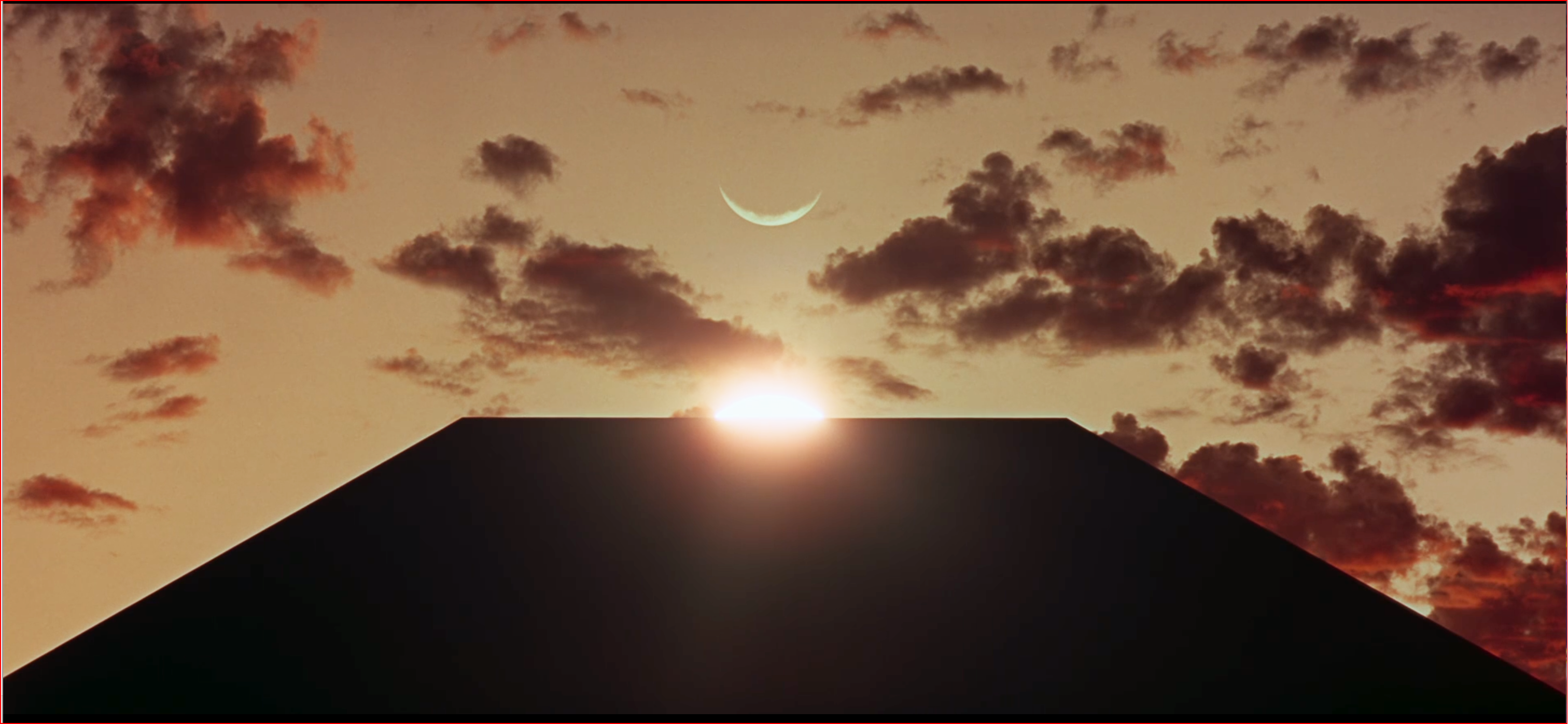
Oh, and the visual nod to the soli-lunar in the film should be obvious:
Every Visitor Must Wear A Badge, Duh!
We also find a “355” in another seemingly unusual place – on the visitor’s badge worn by Dr. Floyd, the creator of HAL, and the mind behind the conspiracy, or, the big mission secret.
Dr. Floyd’s role in the Odyssey is revealed in three sequences: The conversation sequence on Space Station V with the Russians, his briefing in the meeting room at Clavius Crater, and finally in the dismantling of HAL’s innards.
The conversation with the Russians on Space Station V (a five, btw) happens at just over 30 minutes into the film, and after Dr. Floyd bumbles the question about the plague (which we later find out is a cover story), he checks his watch at precisely the 33-minute mark:

“Oh, that quarantine? Nothing to see here! Wow, look at the time, well, I have to be going, nice to meet you, blah blah blah.” Here we see that the “time” is both important, but also a sort of lie.
Soon after, we find Dr. Floyd in the conference room on Clavius Crater. Here is where the symbolism comes together. Notice that the room is surrounded by white rectangles, evoking the dimensions of the Monolith, and talking to 11 other people:

When we see a closeup of him, we notice that his visitor’s badge has not only a Monolith on it, but also the number 355:


Dr. Floyd then departs the room through a door, but it is also a black Monolith:
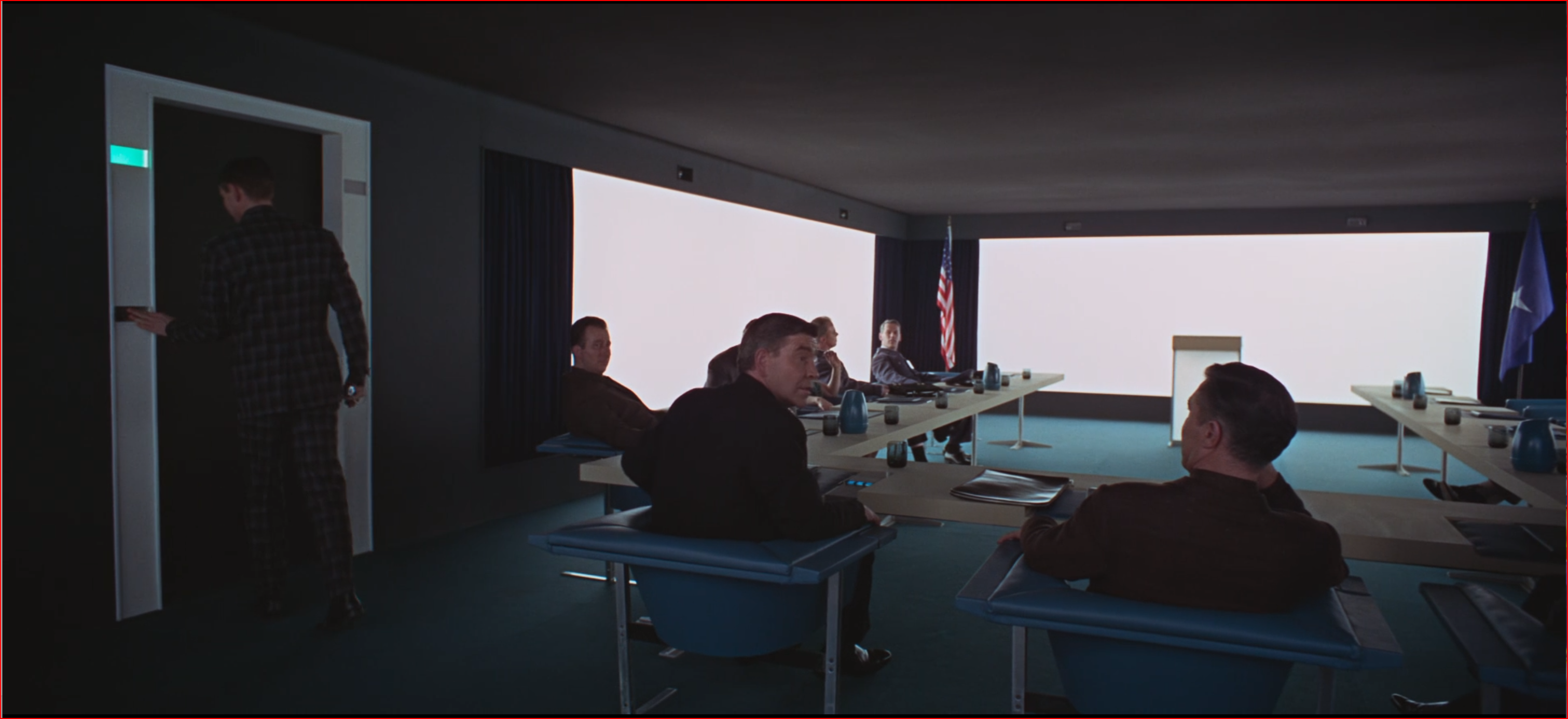
(I don’t really know where black doors exist, but this one had to have a white boundary so we could notice it.)
In any event, why would Dr. Floyd be given badge #355 on Clavius Crater? Well, due to the person whom the crater is named, there was a year with only 355 days in it, as the Gregorian calendar reform simply removed 10 days from the year 1582:
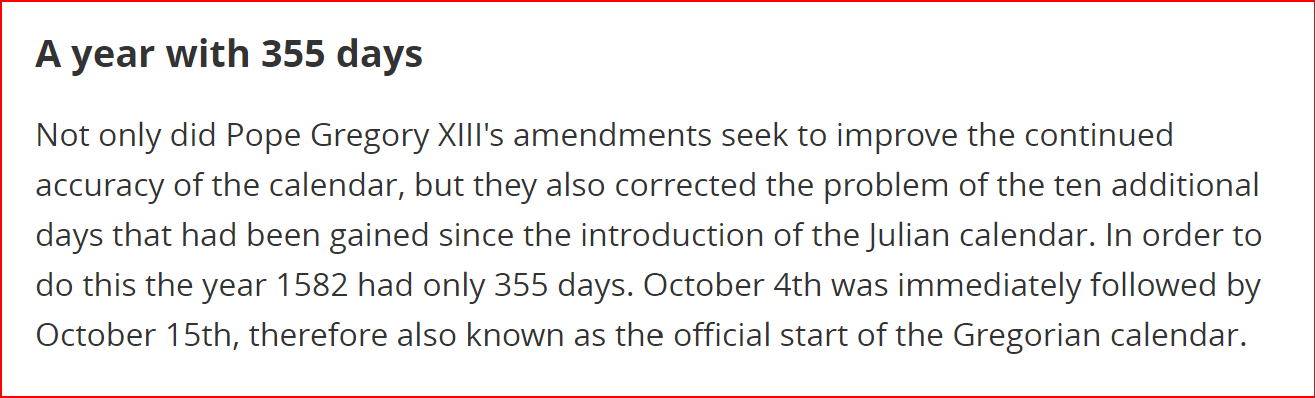
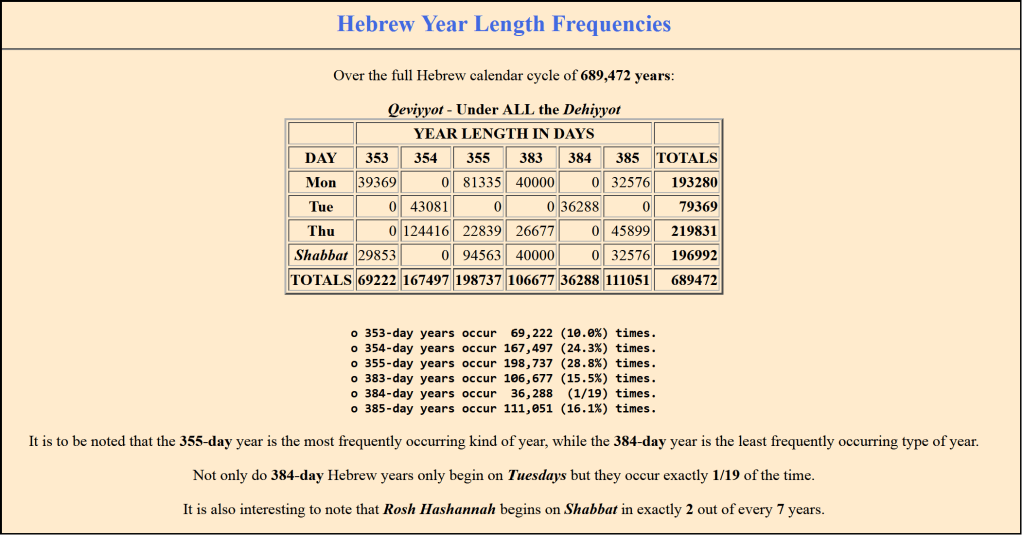
It should also be noted that in the Hebrew calendar scheme, years with 355 days occur most often, as shown by extrapolating the calendar math to the nth degree:
As a final note here, I want to point out that the Gregorian reform was not adopted by the English until 1752; the Crown mandated that the year 1752 would have a September with 11 less days, leaving 19 days. Because 1752 was also a leap year, the total number of days was also 355.
Of course, if there was any doubt that a current of the film was calendars and luni-solar time-reckoning, we need only look at these prominent frames:


If you, dear reader, have made it through all of the above, and don’t want to kill me, we can now jump to the other locale on the Moon in the movie: the Tycho Magnetic Anomaly, named as such because it is very near to the crater named after Tycho Brahe, the illustrious nobleman-astronomer whose meticulous astronomical measurements of Mars’ orbit allowed Johannes Kepler to formulate his Three Laws of planetary motion that introduced the discovery that all planetary orbits are not circles, but ellipses.
Tycho Crater
The nomenclature of lunar craters began with someone most of us have never heard of: Giovanni Battista Riccioli. In the mid-17th Century, he, being a good Jesuit, set out to name the features of the Moon, including craters. Fellow Jesuit Francesco Grimaldi drew up the map:
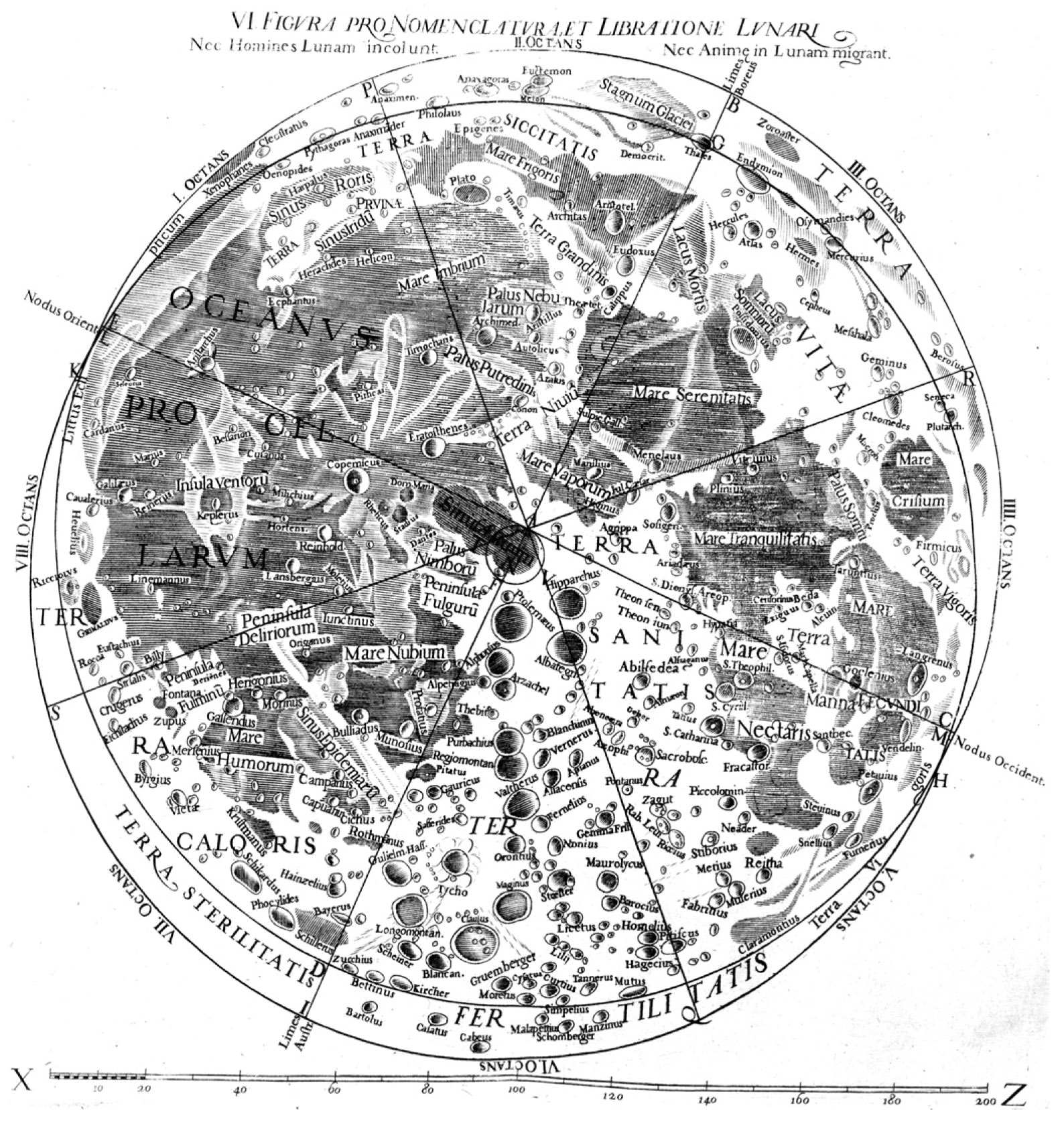
Since then, the craters of Tycho and Clavius have been called Tycho and Clavius, and are adjacent, as seen in this closeup:
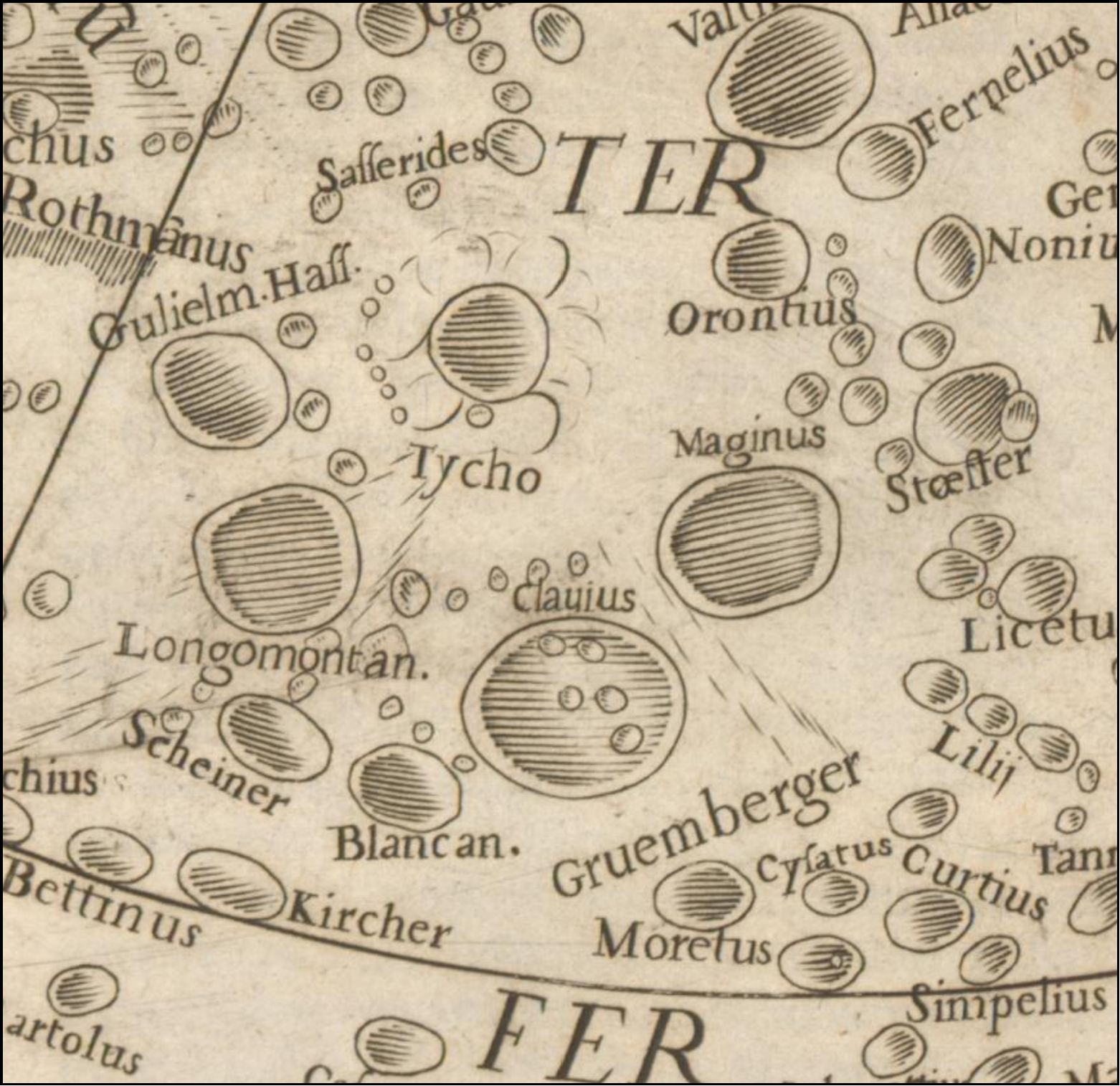
While it looks small here, Tycho is perhaps the most prominent crater on the Moon, given the bright rays of ejecta around it. (To be sure, Riccioli gave Kepler a crater as well, near the area reserved for Copernicans.)
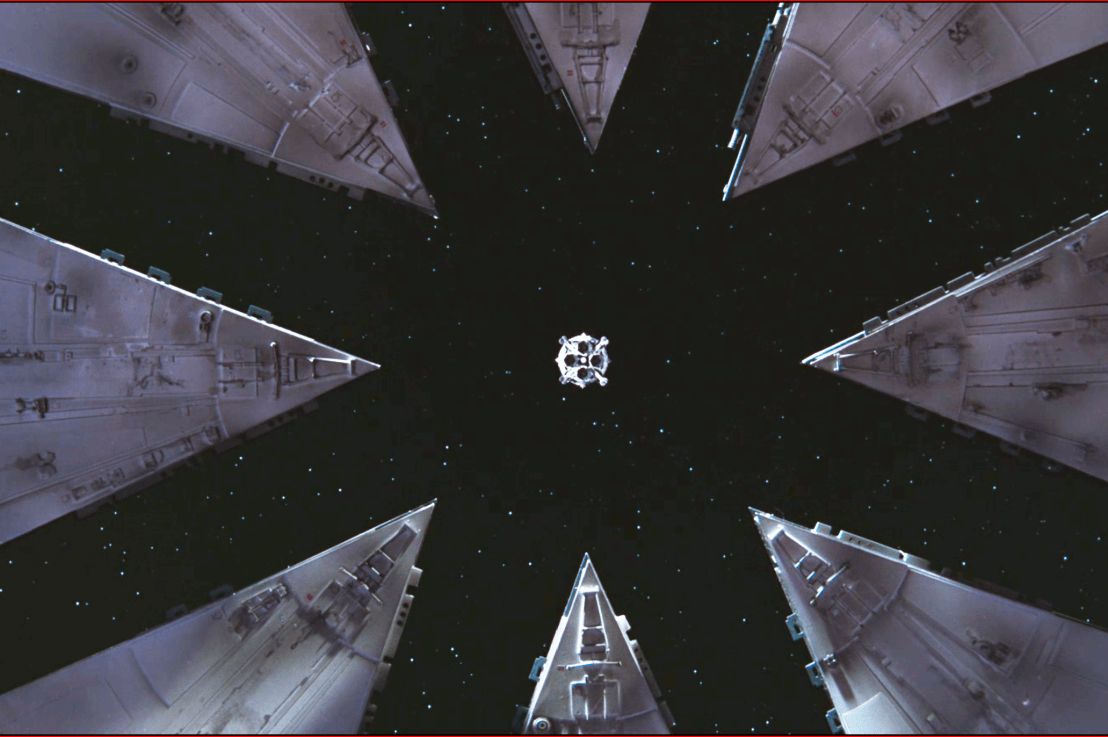
Perhaps as a nod to the Riccioli-Grimaldi map, which has a peculiar “octans” coordinate system, Kubrick chose an eight-sectioned hatch for the entry of space ships into the facility at Clavius Crater:

Mars
In the film, Mars is basically persona non grata. Mars’ omission may have been due to editing, or it may have been purposely implied so deeply that we only had it as a phantasm. Still, my contention has always been that HAL’s color is that of Mars, and that the first sequences of the film are alluding to Mars (violence); there are other locations in the film where the color red dominates, but nowhere does it feel more creepy than in the “Logic Memory Center” of HAL.

From HAL’s eye:

Poole being flooded with HAL red:

The original screenplay did mention Mars, and, lo and behold, the number 79 was tacked on to it with the mention of a probe called “Deep-Space-Monitor-79”:

And, this may just be a fluke, but the number 79 pops up at exactly 79 minutes into the digitized version, right next to a “33”:
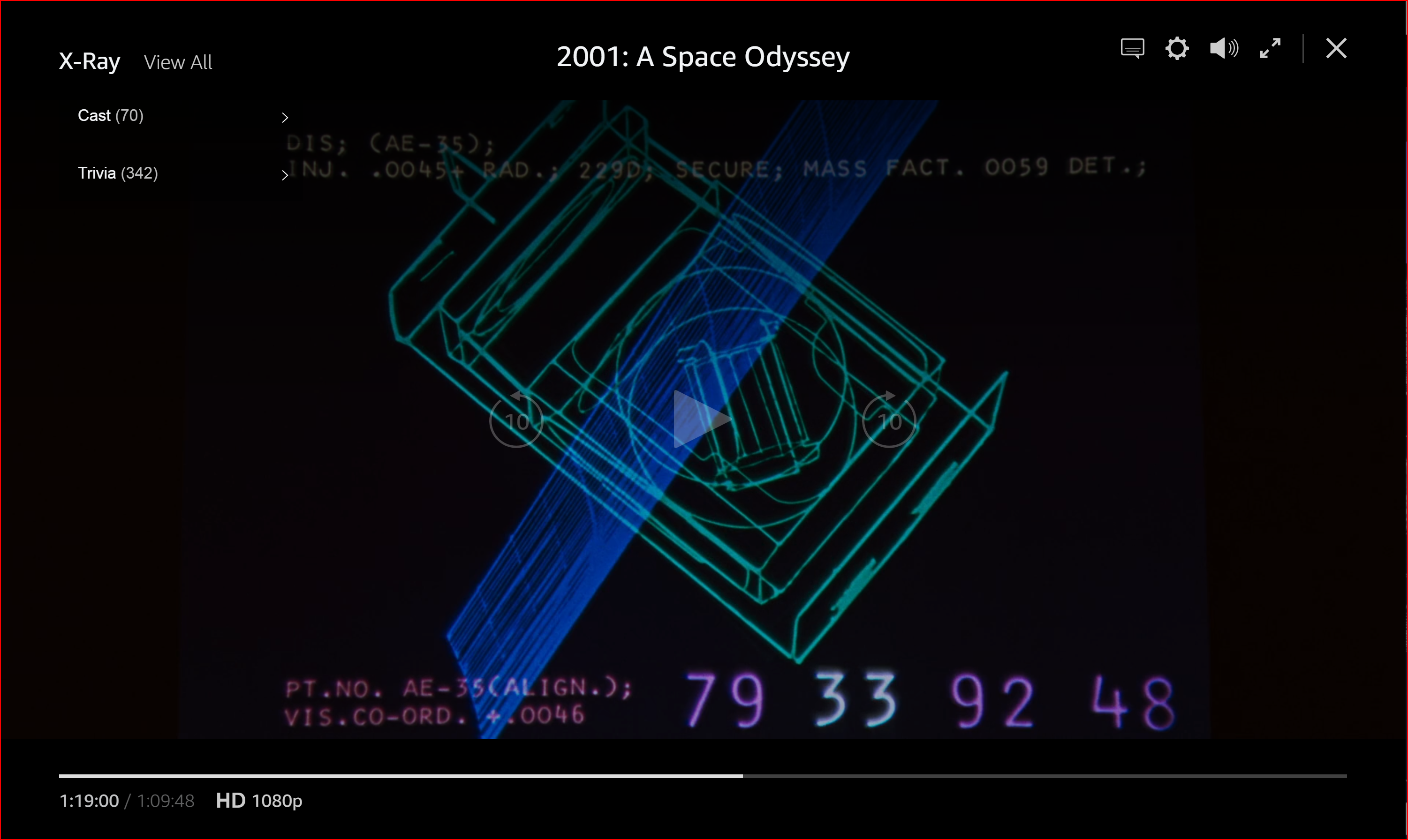
It should be noted here for the non-astronomers that both Mars and Mercury have the most elliptical orbits of all the planets; also, they both share an orbital resonance, and, their own nodes are aligned from our geocentric view. Let me explain…
Babylonian “Goal-Year” values revealed that Mars returns to the same place in the zodiac every 79 years with very accurate precision, and less accurately in 47 years. [An fine example of the 47-year period can be found in the Key Bridge Accident of 2024. Thanks, Judith!] Their Goal-Year value for Mercury was 46, though modern calculations show that a 33-year cycle offers a higher precision.
If we add 46 and 33, we arrive at 79, and be confident that Mercury/Mars conjunctions tend to repeat every 79 years, which they do, within the margin of error of a few days.
Shorter, but less-accurate Goal-Year values can be inculcated as such:
- Merc: 46 – 33 = 13
- Mars: 79 – 47 = 32; 32 = 15 + 17 — components of the SuperMars cycle.
The other Mercury-Mars connection is with their nodes. The nodes of both planets conjoin every year around May 9 in the 20th degree of tropical Taurus:

It should be noted that, over the centuries, the precision of this alignment modulates, and that our current millennium boasts the tightest alignments of the historical period.
As for Kepler and Mars, again, it was the highly troublesome orbit of Mars, as expressed in the Ptolemaic system of epicycles, that bothered Kepler enough to revolutionize astronomy with his theory of oval-shaped orbits.
So, kits, cats, sacks, wives, how many were going to St. Ives? I hope to wrap this up in Part III, where we will fit six 3-4-5 triangles into one Monolith, say hello to Euclid, figure out what Urbana, Illinois, has to do with HAL, why the Tycho Magnetic Anomaly and The Mountain Astrologer have the same acronym, why the astronauts were running in circles, and then talk about trippy LSD-sequence that transports Astronaut Bowman into the bedroom scene. And maybe some astrology as well.
-Ed
- The Hebrew Calendar, long fussed over, has a highly complex mathematical system, as it seeks to keep certain holy days matched with the weekly cycle of named days: https://hebrewcalendar.tripod.com/#24.4 ↩︎
- The Islamic calendar is fundamentally observation-based, but the mathematics of the lunar cycle limit a “year” of 12 lunations (starting with the month Ramadan) to be either 354 or 355 days in length: https://www.timeanddate.com/calendar/islamic-calendar.html ↩︎
 Emersion: A Blog from Occursion Media on Somewhat Interesting Hidden and Cryptic Astrological Histories
2 thoughts on “2001: A Space Odyssey – it’s not a B Movie, but it is a Dee Movie, Part II”