

I don’t want to go through a large explanation of “what is Rosslyn Chapel,” though a brief synopsis of the chapel’s history can be found here. It was originally intended to be a private chapel for the wealthy Sinclair, or St. Clair clan, and not open to the public, though surely plenty of people were invited to attend. It is now open to the pubic as a museum. I created a YouTube playlist of videos that show much of the inside of the chapel, so if you would still like some familiarization with the location, this may help.
The most famous parts of Rosslyn Chapel [henceforth RC] that receive the most attention are the Apprentice Pillar and the Crypt, though other elements of the interior such as the “Green Man” and ??
All of those elements have been researched and written about to the nth degree, but the one outstanding feature of RC that has received short shrift, in my opinion, is the vaulted ceiling. RC scholar Jeff Nisbet has published papers on it here, here, and here, which are the most in-depth looks at the ceiling I have yet to come across.
I should say that I know Jeff, and have talked with him many times. He has been an invaluable help in this part of the book. The last I spoke with him was about five years ago, and after my attempts to explain my own “apprentice” take on the matter, he encouraged me to write it up.
The Ceiling
The ceiling’s relief art is truly unique in the world of gothic style cathedrals and chapels. While vaulted ceilings are about as ubiquitous as it comes, it’s the decorations that make this ceiling enigmatic. As can be seen above, the ceiling is divided into five equal parts. The four eastern sections are adorned with floral motifs, but the fifth section is filled with five-pointed stars; situated within that array are eight non-star reliefs that depict four angels, Jesus, the sun, the moon, and a bird. The starry section is seen below.
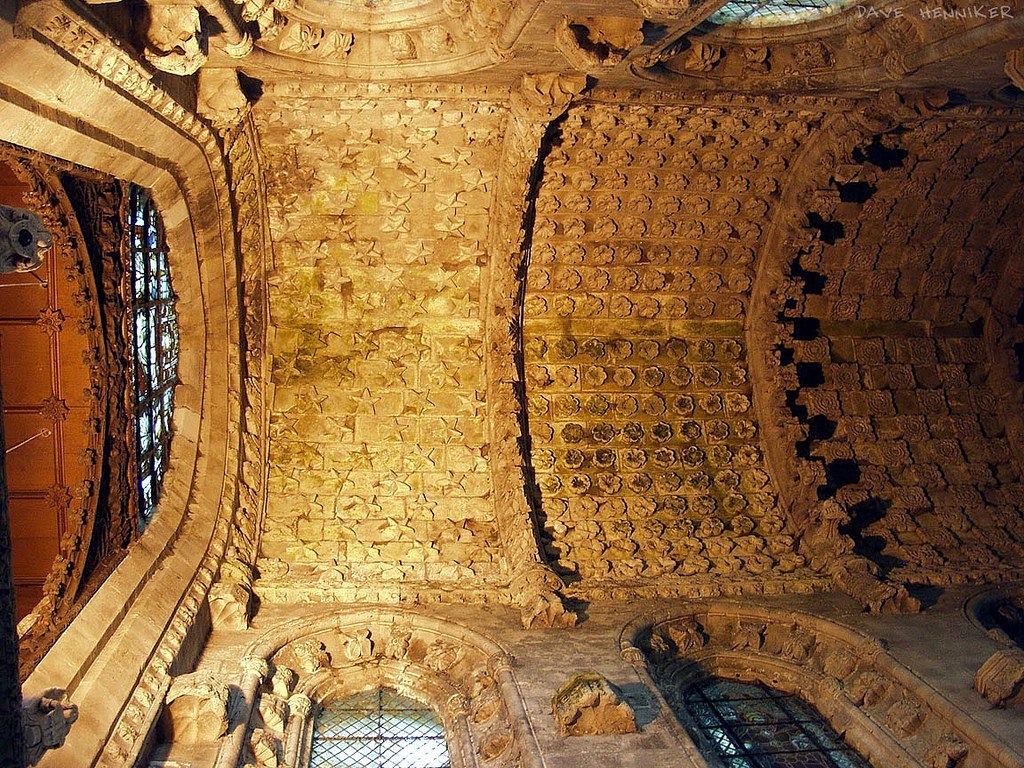
There are some things to note about the array of stars and other items. First, there are 22 “rows” of masonry, with 11 on the north side and 11 on the south side. Each row has four reliefs, for a total of 88 reliefs, with 44 on one side and 44 on the other.
Each side has four non-star reliefs, and so there are 40 stars and 4 non-stars on each side, giving us a total of 80 stars, four angels, Jesus, a sun, a moon, and a bird.
Why did Sinclair construct his ceiling like this? No one really knows, and that’s part of the mystery. Why have 11 courses of masonry on each side instead of 10 or 12? It almost certainly was not because the vault could only accommodate that number of courses to make it structurally sound.
Magical Numbers
Is there anything special about 11, 22, 44 and 88? Well, yes, as they are all “magical” numbers in the sense that they are repeating digits. And, the “22” has a connection to sacred geometry in the sense that that the ancient, and simplistic, formula for the ratio of “pi” π between a circumference and a diameter is 22 ÷ 7. This is explained in my series on the tarot here, as the number of “trump” cards in the tarot deck is 22, and thus the tarot has the π encoded.
Does this ceiling also have π encoded? I say it does, and we have Jeff to thank for this, because it was he who noticed that the ceiling had a “mistake.” Or, maybe it wasn’t a mistake? If we look closer at the south side of the starry array, we find that there is a shift in the pattern:

This shift happens after the seventh course:
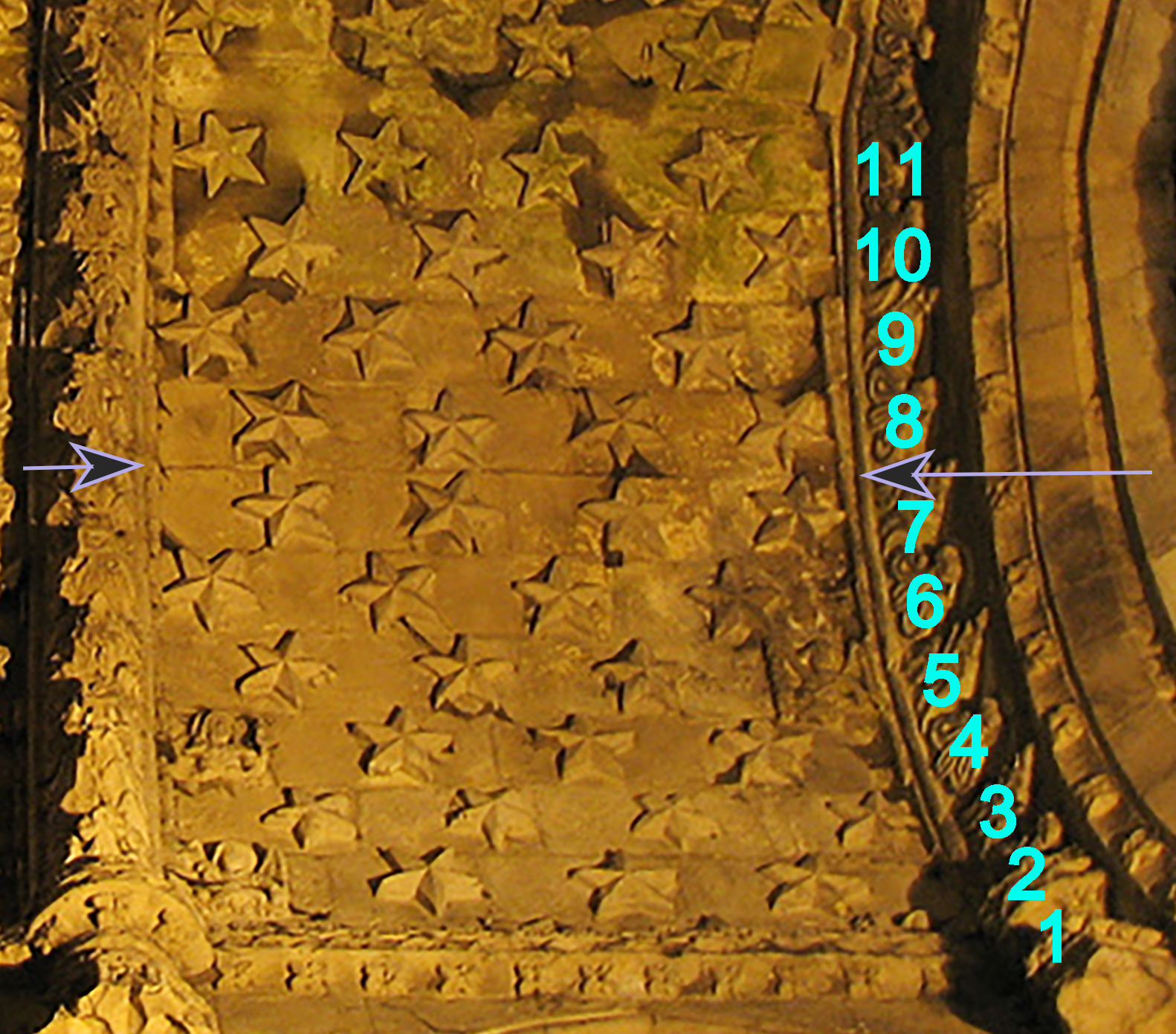
(The lowest “first” course is not visible due to the jutting course that separates the vertical wall from the curved ceiling.) So, while this may be a “mistake,” it is highly doubtful. Sinclair was quite surely putting a π code into this part of the ceiling. But, why π?
The obvious answer is that the sky (where all the stars are) is measured as an arced dome that rotates around the Earth, and the ecliptic, equator, meridian and horizon are all circular measures. (Remember, this was all before Copernicus and Heliocentrism. The Christian thesis in the 15th Century was that the Earth is stationary at the center of the cosmos, and does not rotate, but instead the heavens rotate around the Earth.)
A closer look at the pictures above shows three of the four “angels.” We’ll come back to them later, as the real action is on the north side that has Jesus, the sun, the moon, and a bird.
Jesus, Moon, Bird, Sun
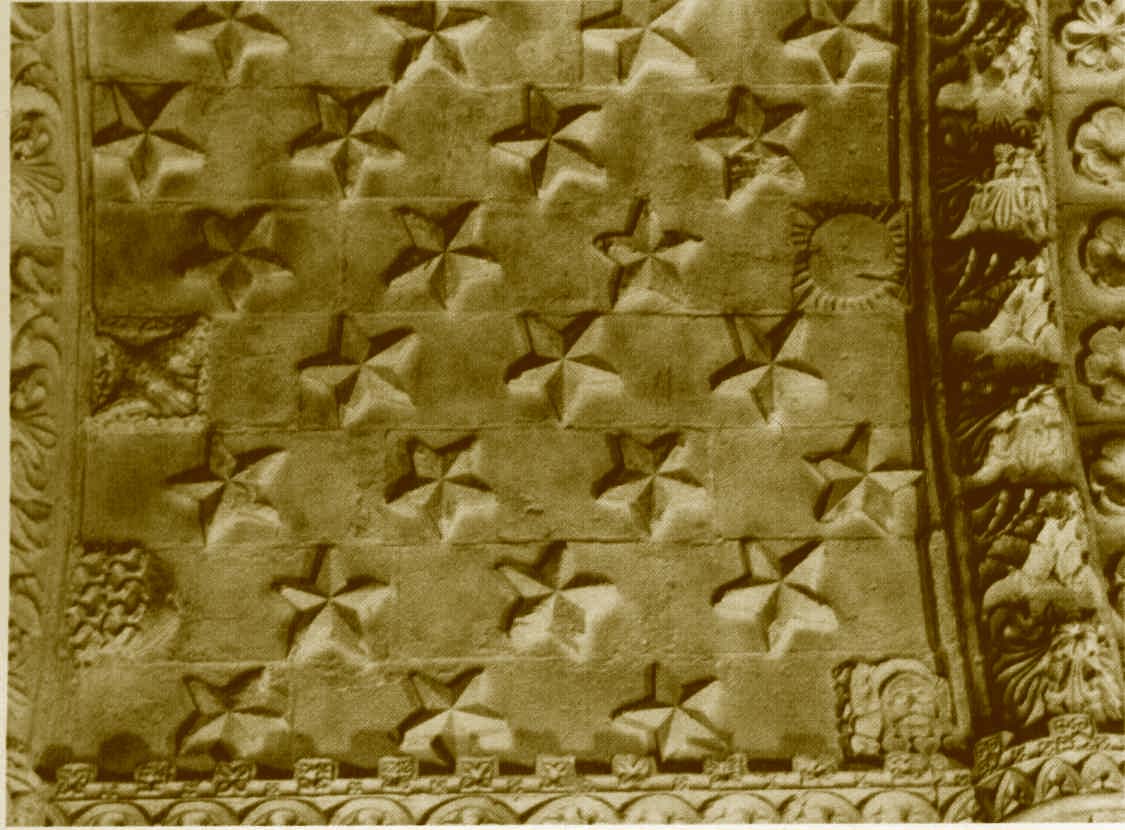
The photo above, courtesy of Jeff, shows the first six courses on the north side of the starry array. We can see a figure that is either Jesus (or God – we are not sure if this was the original relief sculpture from the 15th Century, as some descriptions identify it is as simply a “hand”) on the lower right, a moon in the next course on the left, a bird on the left side of the fourth course, and finally the sun on the right side of the fifth course.
Why were these special figures arranged like this in the array? I cannot find any explanation for this in any reference material. However, we can imagine an order for these items if we simply count them, starting with Jesus:

Which gives us this:
- Jesus = 1
- Moon = 8
- Bird = 16
- Sun = 17
Or, we could include all the slots, including the empties:

Which gives us this:
- Jesus = 1
- Moon = 16
- Bird = 32
- Sun = 33
Which count is the correct count? They both are, as will be show, but here is a quick table:
| Relief Figure | # in count A | # in count B |
|---|---|---|
| Jesus | 1 | 1 |
| Moon | 8 | 16 |
| Bird | 16 | 32 |
| Sun | 17 | 33 |
One easy allusion to draw is that Jesus lived for 33 years and performed 33 miracles (thus the healing hand is raised), and Jesus is derived from the nature of earlier solar deities. Remember — Sinclair is working with information from the Knights Templar as well as traditional dogma from Rome. 33 is a well-known value in astronomy. 34 “lunar years” of 354 days almost perfectly fit in 33 solar years o 365.25 days. Given that a lunar year is 11 days shorter than a regular solar calendar year of 365 days, after three years, a excess of 33 days accumulates; this is important when calculating Easter. Mercury also has a 33-year cycle, where it will return to nearly the same place in the zodiac every 33 years. But, there is another way the 33 fits into Rosslyn astronomy that we’ll learn in this chapter.
Why 17? It is a prime number, and related to the “Star” (Venus) card in the tarot. This is where we start detecting the exaltation of Mars, however, and it has to do with something I’m calling a SuperMars.
SuperMars
The SuperMars is akin to the coined term “Supermoon,” which has now become part of the public astronomical lexicon. A Supermoon simply means a full moon where the moon is also at its closest distance to the earth. The orbit of the moon is like other orbits in that it is not perfectly circular, and so it comes close to the earth once an orbit and moves far away once an orbit – called either a perigee or apogee, respectively.
In Chapter 4.1 we learned that Mars has an unusually eccentric orbit that brings it almost twice as close to Earth when both are in opposition in the Capricorn/Aquarius region, as compared to when the opposition is in Cancer/Leo. (I’m speaking of constellations, not sun signs.)
In Chapter 4.1 we also learned that the magnitude (brightness) of Mars oppositions in Capricorn/Aquarius is over four times brighter than oppositions in Cancer/Leo, and that this was easily noticed by the Ancients, which explains why Mars is exalted at the tail end (literally!) of Capricorn – 28° Capricorn, precisely where the natural fixed star conjunction of Deneb Algedi and Sadalsuud is found in the ancient zodiac re-discovered by Cyril Fagan in the 1950’s (thus the Fagan-Allen zodiac). [See Appendix B.]
SuperMars Periodicity
There is a SuperMars cycle that is easily predictable and has its own mathematical properties. It is a bit complicated, but not impossible to understand with some basic math. I’m inventing the taxonomy of this and calling it the Mavortial Cycle.

There are three basic year counts in the Mavortial Cycle: 15, 17, and 363. In the sidereal zodiac, we can reliably predict a return of any SuperMars event every 363 years to within one degree of arc. If we are moving forward in time, we would add ~43′ of arc, and if we are moving backward in time, we would subtract ~43′ of arc. Taking the two recent SuperMars events, from both 2003 and 2018, we can show these results from the ephemerides:
| Date of SuperMars | Posit in Fagan-Allen | Astronomical Units |
|---|---|---|
| Aug 21 1640 NS | 09°Aq29′ | 0.3735 |
| Aug 28 2003 | 10°Aq13′ | 0.3727 |
| Sep 3 2366 | 10°Aq53′ | 0.3724 |
| Date of SuperMars | Posit in Fagan-Allen | Astronomical Units |
|---|---|---|
| Jul 21 1655 NS | 08°Cp23′ | 0.3844 |
| Jul 27 2018 | 09°Cp09′ | 0.3850 |
| Aug 1 2381 | 09°Cp53′ | 0.3854 |
A couple of things to take note of here: The dates advance by an average of five calendar days between events, but that is due to precession notching about an even 5° in 363 years (72 × 5 = 360). The posits advance a bit over 2/3 of a degree between events, and so over many tens of thousands of years the sequence will move out of the SuperMars zone. I’m defining, for the purpose of this book, that a SuperMars must be less than 0.4000 A.U., so the zone is basically the span of Fagan-Allen zodiac between ~25° Sagittarius and ~14° Pisces, around 80° of arc. The center of the zone is at ~5° Aquarius, not too far off from 28° Capricorn, and actually very close to the longitude of the fixed star Fomalhaut. (More on that star later as well.)
Here’s some real data from the last 363-year Mavortial Cycle from 1687 through 2050 which shows the math:

Looking more closely at Table 4.3-d, we can see that sometimes there are 15 years between two SuperMars events, and sometimes there are 17. There is only one way to solve this equation:
[15a + 17b = 363] = [(15×14) + (17×9) = 363] = [210 + 153 = 363]
14 + 9 = 23, thus one standard Mavortial Cycle will take 23 advances to repeat, and thus the cardinal count of 24 events. Sometimes we come across a situation where 25 events are found in one Mavortial Cycle, and one such example is in the light blue shading above. The 1702 and 1704 data are almost the exact same A.U. value, and both are at the extremes of the SuperMars zone, so we have to include both.
The right-hand column shows that exactly fourteen 15-year differences and nine 17-year differences yield the 363-year Mavortial Cycle, minus the 2-year interval between 1702-4.
We could do some quick math, knowing that the average advance of a Mavortial Cycle is about 2/3 of a degree, and estimate the aeonic length of a SuperMavortial Cycle with this formula:
363 × (360 ÷ 42/60) = ~186,686 years
… which is about how long it feels like when sitting in traffic on the 405, right? Seriously, though, this is about 1/4 of the time homo sapiens is believed to have been present on the Earth. It’s a very long cycle.
The SuperMars of 1450 and Rosslyn
OK, back to Rosslyn. If the ceiling has a nifty 17 stealthily encoded in the Jesus side of the ceiling, we have at least one possible clue that Mars is in the mix. In Chapter 4.1, it was mentioned that RC was dedicated in 1450, a year of a SuperMars. Here is the data for that opposition:
July 16, 1450 — 14°Cp43′ — 0.3790 A.U. — Magnitude -2.8
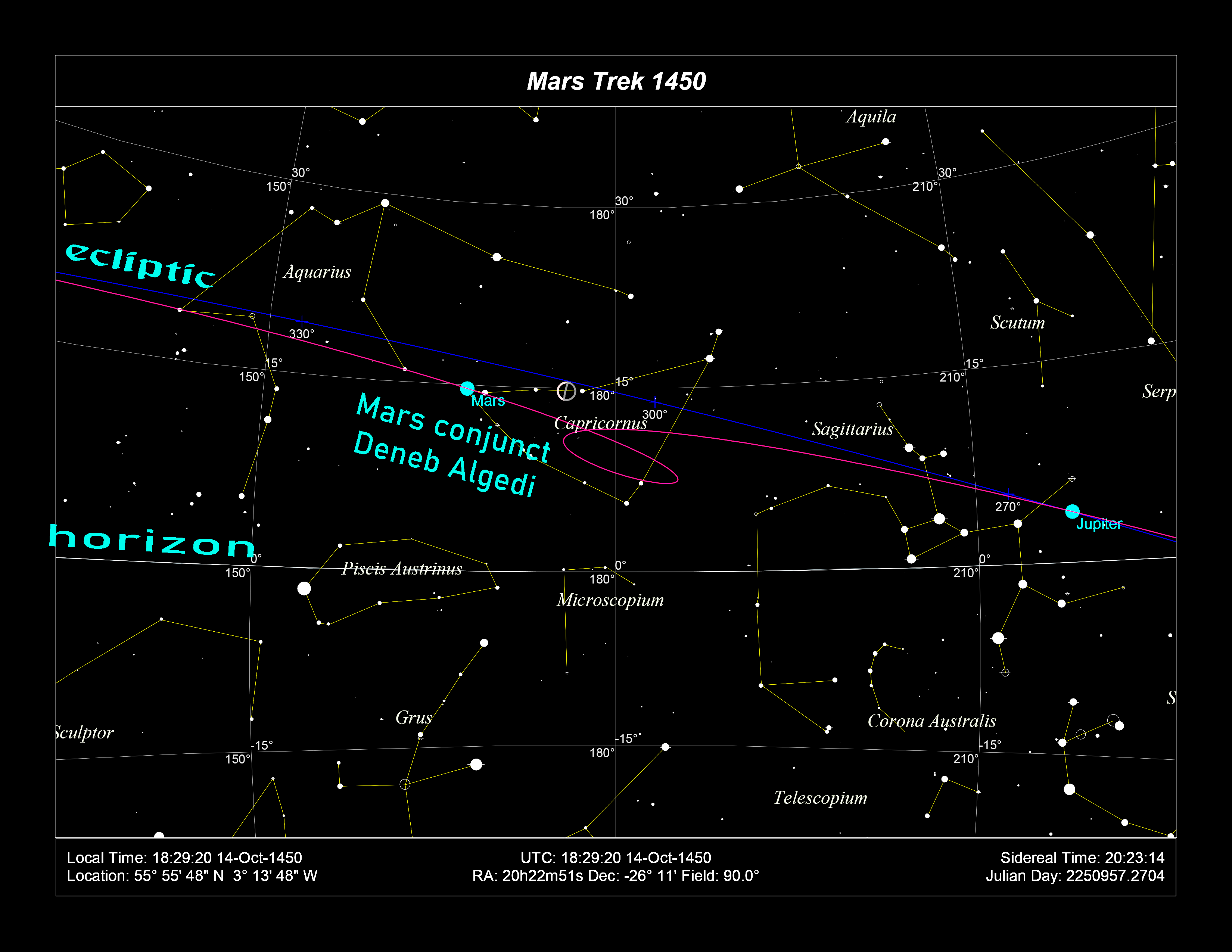
A sky map of Mars culminating over Rosslyn is below. This map shows the trek of Mars in mauve as it moved through the heavens, starting from the right side of the map and moving to the left, circling/retrograding within Capricorn, and then moving out, passing directly over Deneb Algedi, iota Aquarii, and finally phi Aquarii (underneath the “i” in “ecliptic”).

Mars’ magnitude dwindled rapidly by September 21, only 67 days later, to -1.3, but the SuperMars was in the books. On the 22nd, the day after St Matthew’s Day, Mars crosses back over its own trek:

On October 15 Mars then moves into a very tight conjunction with Deneb Algedi, which we know is it’s own exaltation-star, as well as a Behenian star, and which, along with Sadalsuud in Aquarius, aligns with the center of the Northern Cross:
On the 24th of October, in what can only be called a remarkable dual-alignment, Mars makes a very close conjunction with iota Aquarii, also called 33 Aquarii, while Venus makes an extremely close conjunction with theta Ophiuchi:

Given all of these very interesting alignments and phenomena, I think we would be hard-pressed to assume that astrology did not play a role in the the dedication of Rosslyn Chapel. All of it could have been calculated well in advance by adept Renaissance astrologers, and we know the Sinclairs could easily afford those services. William Sinclair did travel to the Vatican to obtain permission for his edifice, and then traveled to meet with masons in various parts of Italy and France to hire craftsmen.
Magic numbers are always important, and if you’ve been doing up some math in your head while reading this, you might have realized that 363 = 11 × 33, which brings us fill circle to the Sun relief in the north side of the ceiling’s starry array! Here it is again:
The prime factorization of 363 is simply 3, 11, 11. Is this also why the vaulted ceiling has two sides of 11 courses of masonry? The Baphomet is in the details, isn’t it!
Where does the Rosslyn SuperMars fit into Hidden Dan-Brownian History?

When I first set out to study and learn about the SuperMars cycle, I ran calculations for 4500 years, from 2000 BCE to 2500 AD. The table at left lists all the SuperMars events that are either 363 years before or after 1450.
The years listed here offer up some very interesting milestones, in both Christian history and Templar/Masonic history.
And, if you know me, you know there’s always more to the story, and the identity of that bird will be clarified in Chapter 4.4.
-Ed
 Emersion: A Blog from Occursion Media on Somewhat Interesting Hidden and Cryptic Astrological Histories
🫶✨🤍
I’m mars 44! 4 NN